Introduction
In industrial automation, energy storage, machine control, and electrical cabinet applications, 380VAC to 24VDC power supplies are widely employed as essential power conversion components. They provide regulated DC power for PLCs and sensors, as well as for relays, contactors, communication devices, and various control circuits.
The most common engineering mistake is to select the power supply based solely on the steady-state load. This approach may appear reasonable under normal operating conditions. However, the actual power demand of an electrical cabinet can increase significantly during startup or transient operating conditions.
A cabinet may consume only 6A during normal operation, but it may require substantially higher current during system startup. This increased demand can occur when contactors, solenoids, motors, or multiple control modules are energized simultaneously.
1. Confirm What “380VAC” Actually Means
Before selecting the power supply, it is essential to confirm whether the specified 380VAC refers to the three-phase line-to-line voltage. This distinction is important because the actual voltage relationship depends on the connection and measurement method used within the industrial power system.
In a typical industrial three-phase system, the line-to-line voltage is approximately 380–400VAC. By comparison, the line-to-neutral voltage is approximately 220–230VAC. Therefore, the voltage definition should be verified before determining the appropriate power supply input specification.
This distinction is critical. A conventional 220/230VAC single-phase power supply cannot simply be connected between two phases of a 380VAC system.
If neutral is unavailable or the cabinet is designed around the three-phase bus, use a power supply specifically rated for 3-phase 380/400VAC input.
2. Size the 24VDC Output for the Real Load
Do not select a 24VDC power supply only from the nominal current listed on the equipment nameplate.
Required current = continuous load + startup/peak load + engineering margin.
If the measured continuous load is 7A, selecting a 7A supply leaves almost no operating margin.A practical starting point is 20–30% headroom, followed by verification against the manufacturer's derating curve.
3. Check Inrush Current Before Finalizing the Model
One of the most overlooked causes of 24VDC startup failure is inrush current. A system may operate perfectly after startup but repeatedly shut down when powered on. Typical causes include large DC-link or input capacitors, multiple PLC/I/O modules starting simultaneously, contactors and solenoids, DC motors, long DC wiring, and multiple power supplies starting at the same time.
Industrial supplies often specify peak-power capability or dedicated inrush-handling functions for high-startup loads. Do not confuse overload capacity with continuous output rating. A temporary peak rating cannot be treated as a permanent operating capability.
4. Thermal Derating Is Often More Important Than Rated Power
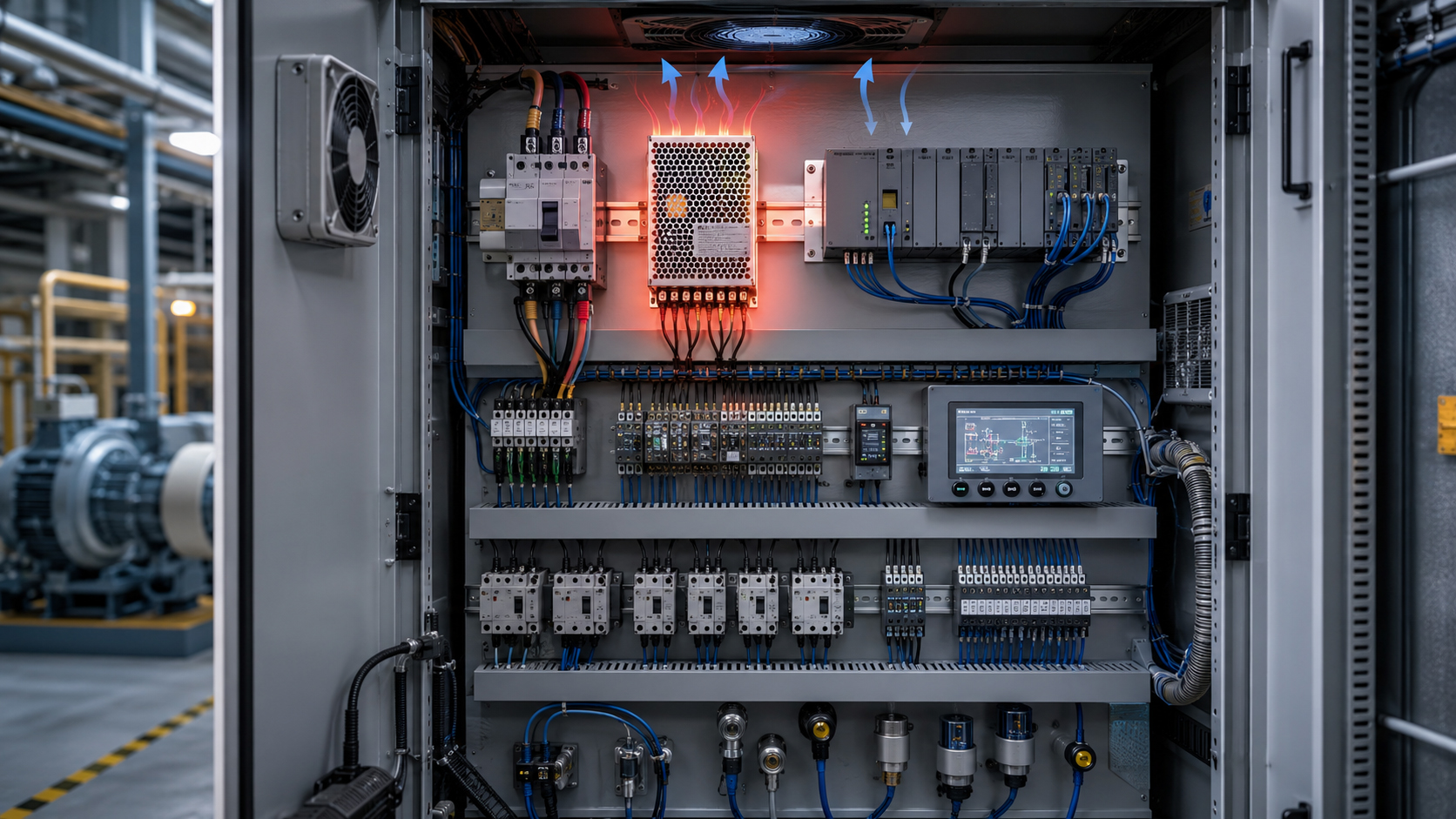
A 240W power supply may deliver 240W under specified conditions but may require derating at elevated ambient temperature. This becomes critical inside sealed electrical cabinets, outdoor equipment, energy-storage containers, motor-control cabinets, and high-density automation panels. Do not size the supply from room temperature. Size it from the worst-case temperature inside the cabinet.
5. Investigate 24VDC Voltage Drop at the Load
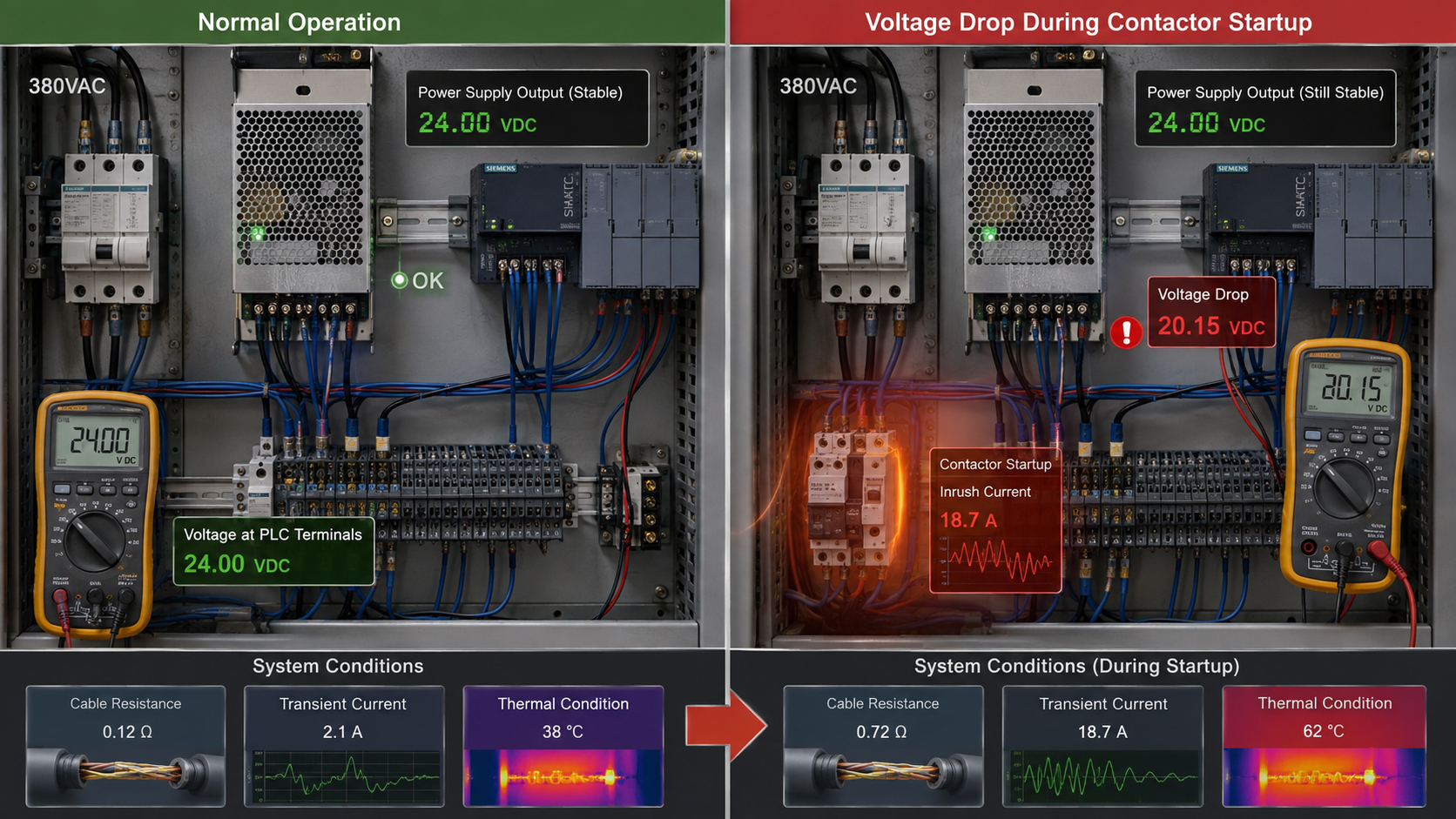
A power supply can output a stable 24VDC while the PLC or sensor receives only 21–22VDC. This is commonly caused by undersized cables, excessively long DC wiring, loose terminals, corroded connectors, high-current actuators sharing the same branch, or poor DC distribution design. Always measure voltage at the actual load terminals while the equipment is operating. Do not measure only at the power supply output.
6. Protection and Three-Phase Reliability Matter
For industrial applications, check short-circuit protection, overload protection, overvoltage protection, input surge protection, inrush-current limitation, overtemperature protection, input fuse or breaker requirements, and output diagnostic capability. Three-phase supplies should also be evaluated for phase-loss and abnormal-input behavior.
7. Practical Selection Table
Application Condition | Recommended Selection Focus |
PLC + sensors | 24VDC, 20–30% power margin |
PLC + relays + contactors | Check peak/inrush capability |
High-temperature cabinet | Verify derating curve |
Long DC cable | Check voltage drop and output adjustment |
ESS / outdoor cabinet | Temperature, surge and protection |
High-power control cabinet | Consider 3-phase 380–480VAC input |
Critical control system | Consider redundancy / parallel operation |
8. A Typical Field Failure: “The Power Supply Is Large Enough”
A machine was designed with approximately 8A continuous 24VDC consumption. A 10A power supply was installed, so the design appeared adequate on paper. During commissioning, however, the PLC occasionally rebooted when several contactors operated simultaneously.
The investigation found that the supply voltage itself was stable, but the 24VDC voltage at the remote PLC dropped significantly during the switching event. The actual problem was not insufficient rated power. It was a combination of transient load current, DC wiring impedance, and insufficient distribution design.
The solution was to separate high-current actuator branches from sensitive control branches, improve DC cable sizing, shorten high-current wiring, verify the supply's peak-current capability, and measure voltage directly at the PLC terminals during the worst-case event. This type of troubleshooting is far more useful than simply replacing the power supply with a higher-wattage model.
9. Don't Select Only by Datasheet Wattage
For a 380VAC to 24VDC application, the correct selection sequence should be:
Input system → Output load → Peak current → Temperature → Voltage drop → Protection → Reliability → Certification → Mechanical installation.
A 24VDC power supply that passes the first three checks can still fail in the field because of thermal stress, wiring losses, startup behavior, or environmental conditions.
For projects involving 380VAC/400VAC three-phase input, customized 24VDC output, high transient loads, redundancy, isolation, or special environmental requirements, standard catalog selection may not be sufficient. Need a customized isolated or bidirectional power topology? Submit your electrical parameters to the IDEALPLUSING senior engineering team for a free evaluation. The engineering review should include input voltage range, output voltage/current, peak load, operating temperature, isolation requirements, installation environment, protection requirements, and application conditions.
Conclusion
Choosing a 380VAC to 24VDC power supply is an application-engineering decision, not simply a voltage conversion decision. The most reliable design considers three-phase input compatibility, continuous and peak load, inrush current, thermal derating, DC voltage drop, protection, and actual operating conditions. In industrial projects, measuring the system under its worst operating condition is often more valuable than simply selecting a larger power supply.