Introduction
Industrial inverters are widely used in motor drives, energy storage systems, UPS equipment, renewable energy systems, and industrial automation. Although the basic function is DC-to-AC conversion, field failures rarely come from the conversion principle itself.
In real projects, problems are more often caused by incorrect sizing, insufficient overload capacity, poor thermal conditions, unsuitable DC input, excessive harmonics, wiring errors, or communication incompatibility.
Therefore, an inverter should be selected as part of the entire electrical system—not as an isolated power device.
1. Understand the Inverter from the Application
The first question should not be “How many kW do I need?”
Instead, identify the actual load: motor, pump, fan, conveyor, compressor, battery energy storage system, UPS, renewable energy system, or industrial control equipment.
Different loads create different electrical stresses. A pump may have relatively predictable load behavior, while a conveyor or hoist can generate high starting torque and regenerative energy.
2. Selection: Power Rating Is Only the Starting Point
A common field mistake is selecting an inverter only according to motor power.
Engineers should also check:
Parameter | What to Check |
Input voltage | Normal and maximum DC voltage |
Output voltage | AC voltage and frequency |
Rated current | Continuous load current |
Overload | Startup and transient demand |
Load profile | Constant, variable, or dynamic torque |
Environment | Temperature, humidity, dust, altitude |
Cooling | Natural, forced-air, or liquid cooling |
Communication | CAN, RS485, Modbus, etc. |
A correctly rated inverter can still fail if the actual load profile was ignored. Current-based sizing and overload capacity are especially important in dynamic applications.
3. Common Industrial Inverter Failures
In troubleshooting, the alarm code is only the starting point.
Overcurrent trips may result from excessive startup torque, acceleration time that is too short, mechanical blockage, incorrect motor parameters, or an undersized inverter.
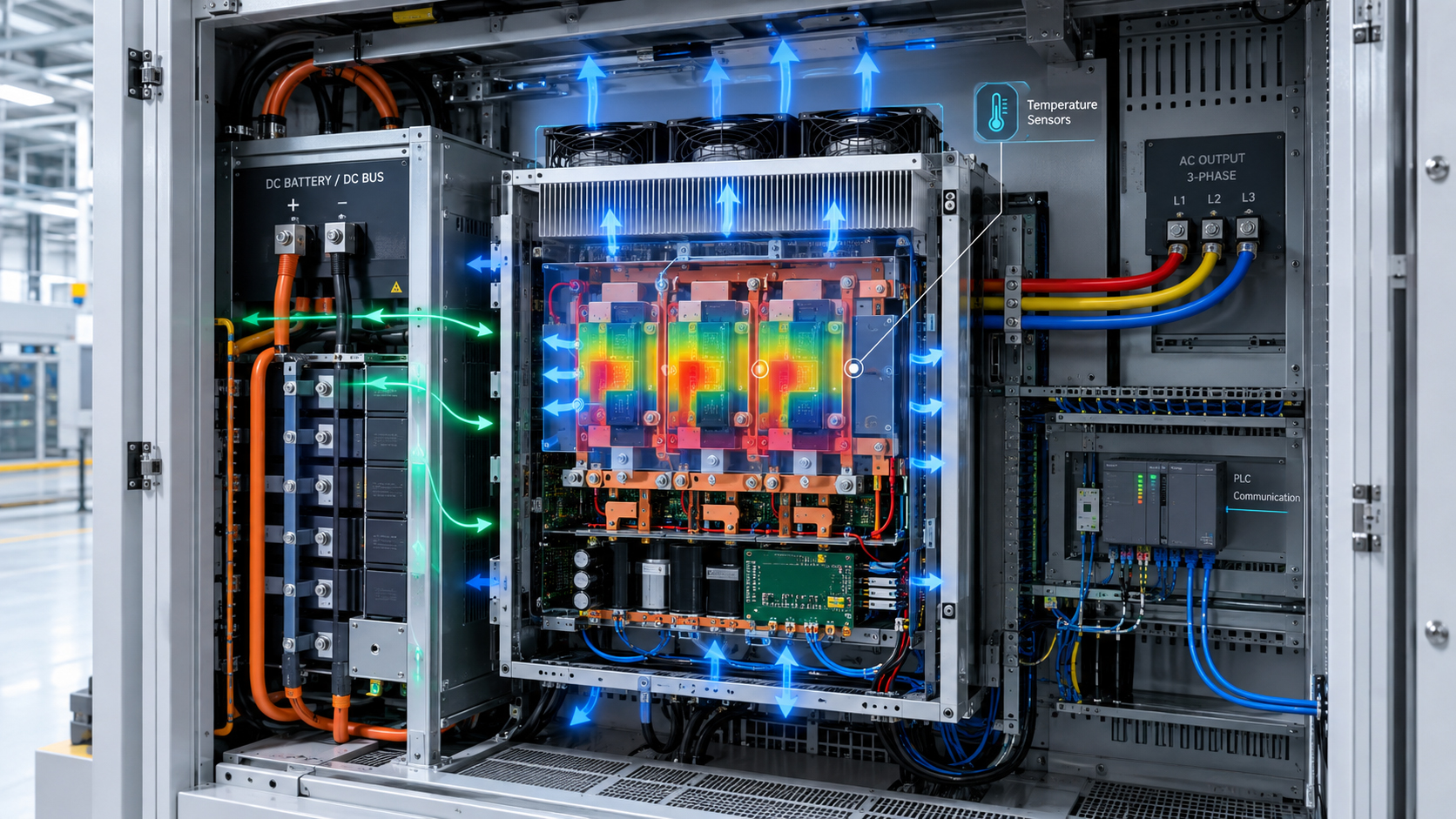
Overtemperature does not always mean the inverter is defective. Check cabinet ventilation, ambient temperature, heatsink contamination, fan operation, switching losses, and actual loading.
DC bus undervoltage in battery systems may be caused by voltage sag under high current.
Communication failures may occur even when the power stage operates correctly because CAN, RS485, Modbus, or PLC parameters are incorrectly configured.
4. Project Experience: “Rated Power Is Enough” Does Not Mean “System Is Safe”
In one typical industrial application, the selected inverter had sufficient continuous power for the motor. However, the system repeatedly tripped during acceleration.
The investigation showed that the problem was not continuous power. The mechanical load required significantly higher starting torque, while the selected inverter had insufficient short-term overload capability.
The solution was to evaluate the load curve, acceleration profile, motor current, and overload duration together, rather than simply increasing the inverter's nominal power.
5. Application and Reliability: Look Beyond the Datasheet
For energy storage and industrial applications, reliability depends heavily on thermal management, protection strategy, wiring, grounding, EMC, and maintenance conditions.
A practical commissioning checklist should include:
DC input → output waveform → load current → temperature rise → protection response → communication → long-duration operation.
Do not stop testing after the inverter starts successfully. Many failures only appear after continuous operation or under peak load.
For projects requiring bidirectional power flow, galvanic isolation, high-voltage DC input, or application-specific topology, standard products may not always provide the required electrical architecture.
IDEALPLUSING provides engineering support for customized power conversion solutions.
Need a customized bidirectional isolated topology? Submit your electrical parameters to the IDEALPLUSING senior engineering team for a free evaluation.
Conclusion
Industrial inverter selection is ultimately a system engineering problem.
Power rating is only the beginning. Engineers should evaluate load behavior, current, overload, thermal conditions, DC-bus stability, EMC, protection, communication, and application requirements together.
The most reliable solution is not necessarily the largest inverter. It is the inverter whose electrical and thermal characteristics match the real operating conditions of the system.