
An Aviation GPU, or Ground Power Unit, provides electrical power to an aircraft while it is on the ground. Depending on the aircraft and ground-support configuration, the GPU can supply electrical power for activities such as aircraft turnaround, maintenance, inspection and ground testing without relying entirely on the aircraft's onboard power sources.
One specification frequently encountered in aircraft ground power is 115V 400Hz AC.
For engineers and airport equipment buyers, the important question is not simply why the number is 400Hz. It is also why stable voltage and frequency output matter when the GPU is connected to aircraft systems or aircraft-related ground equipment.
Aviation electrical systems can be sensitive to the quality and characteristics of their external power source. A GPU therefore needs to be evaluated as part of the complete ground-power system rather than as a simple AC generator.
For international buyers, understanding the relationship between voltage, frequency, load behavior and protection can help establish an appropriate specification before requesting an aviation power-supply quotation.
1. Aircraft Ground Power Is More Than an AC Outlet
A ground power unit is part of an aircraft's ground-support environment.
When external power is connected, the aircraft-side electrical system expects the supplied power to remain within its specified operating conditions.
For this reason, buyers should consider more than nominal output power.
Important parameters can include:
· Output voltage
· Output frequency
· Phase configuration
· Voltage regulation
· Frequency stability
· Load capacity
· Transient response
· Protection functions
· Cable and connector configuration
· Environmental operating conditions
A GPU with the correct nominal voltage but unsuitable frequency characteristics may not satisfy the requirements of the intended aircraft or ground equipment.
2. Why 400Hz?
Commercial electrical grids commonly operate at 50Hz or 60Hz, while many aircraft electrical systems use a higher frequency.
A major engineering reason is that increasing AC frequency allows magnetic components such as transformers and motors to achieve the required electrical performance with smaller and lighter components for a given power level.
Weight is an important design consideration in aviation.
However, the use of 400Hz also means that conventional 50/60Hz utility power cannot simply be connected directly to equipment requiring 400Hz power.
A ground power system or frequency converter is therefore required to provide the appropriate electrical output.
3. Frequency Stability Matters
The number 400Hz describes the nominal frequency, but a buyer should also consider how closely the actual output follows the required frequency during operation.
The GPU may experience changing loads as connected aircraft systems are energized or de-energized.
If the power source does not respond appropriately to load changes, voltage or frequency behavior can become an important system consideration.
Therefore, engineers should evaluate:
Nominal output → Regulation → Load response → Protection → Testing
rather than evaluating frequency as a single number on a datasheet.
4. Incorrect Specification Can Increase Project Risk
An aviation GPU is normally integrated into a larger ground-support environment.
If the initial specification is incomplete, problems can emerge later:
· Incorrect output configuration
· Insufficient continuous power capacity
· Incompatible connectors
· Inadequate cable configuration
· Unclear protection requirements
· Insufficient documentation
· Additional engineering changes before delivery
These issues can increase engineering time and potentially affect installation or commissioning schedules.
For overseas procurement, correcting a specification after production or shipment can be particularly inconvenient.
This is why application requirements should be clarified before selecting the equipment.
Working Principle
An AC aviation GPU or 400Hz frequency-conversion system generally performs several stages of power conversion.
A simplified architecture can be represented as:
AC Input → Power Conversion → DC Link / Intermediate Stage → Inverter → 400Hz AC Output
The exact architecture depends on the equipment design.
The conversion stage allows the system to generate an AC output with the required voltage and frequency characteristics.
For a typical 115V/400Hz aviation application, the engineering objective is not simply to generate an output at 400Hz. The system should also maintain the required voltage and frequency characteristics when the load changes within the specified operating range.
A simplified output evaluation can therefore include:
Parameter | What Engineers Should Evaluate |
Output voltage | Nominal voltage and allowable operating range |
Frequency | Nominal 400Hz and required stability |
Phase | Required phase and connection configuration |
Power rating | Continuous and applicable peak/load requirements |
Voltage regulation | Output behavior as load changes |
Frequency response | Frequency behavior during load changes |
Waveform | Output waveform quality according to application requirements |
Protection | Over-current, over-voltage, short-circuit and other applicable protections |
Cooling | Cooling method and operating environment |
Interface | Control, monitoring and communication requirements |
The exact acceptance limits should always be established from the applicable aircraft, equipment or project specification.
Selection Guide / Comparison
When selecting an aviation ground power unit, buyers should first distinguish between the required application.
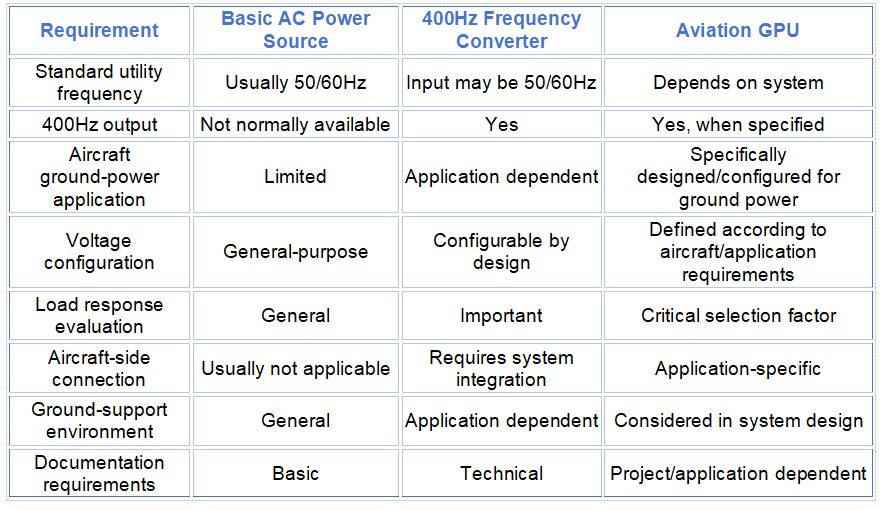
This comparison does not mean that every aviation application requires the same GPU architecture.
The correct configuration depends on the aircraft electrical requirements, available input power, required output, installation environment and intended operating conditions.
Five Questions to Ask Before Selecting an Aviation GPU
1. What is the required aircraft-side voltage?
Confirm whether the application requires 115V, a 115/200V three-phase configuration, or another aircraft-specific configuration.
2. Is 400Hz mandatory?
Do not assume that every aircraft ground application uses the same electrical configuration. Confirm the applicable aircraft or equipment specification.
3. What is the actual load profile?
Define continuous load, startup conditions, variable loads and any relevant transient requirements.
4. What connection system is required?
Cable length, connector type, phase configuration and grounding requirements should be established before production.
5. What testing and documentation are required?
International buyers should define factory testing, inspection records, technical documentation and any project-specific certification requirements before ordering.
Technical Solution
For an aviation ground power project, customization should begin with the electrical and application requirements.
At IDEALPLUSING, an aviation power-supply discussion can start with the customer's required input, output, power rating, frequency, operating environment and integration requirements.
Depending on the project, the technical configuration can be discussed around:
Stable 400Hz Output
The power-conversion system can be configured around the required 400Hz operating condition.
The target voltage and frequency should be confirmed against the customer's applicable aircraft or equipment requirements before production.
Output Configuration
For aviation applications, the required output configuration can involve more than a single voltage value.
Engineers should confirm:
· Voltage
· Frequency
· Phase
· Power
· Current
· Connection configuration
· Control requirements
Protection and Monitoring
Protection functions should be considered according to the system design and application.
Potential areas for evaluation include:
· Over-voltage protection
· Over-current protection
· Short-circuit protection
· Over-temperature protection
· Fault indication
· Output monitoring
The actual protection configuration should be defined according to the final technical specification.
Testing Before Delivery
For international buyers, factory testing provides an opportunity to verify the agreed configuration before shipment.
A project-specific test plan may include verification of:
· Input conditions
· Output voltage
· Output frequency
· Output current/power
· Load behavior
· Protection functions
· Control/interface functions
· Continuous operating performance
The exact test items and acceptance criteria should be agreed upon before production.
Planning an aviation GPU project?
Send us your required voltage, frequency, power rating, aircraft/ground-equipment application and installation requirements. Our engineering team can help clarify the key specifications before you request a quotation.
Application Case
Aviation Ground Power for Maintenance and Ground Operations
A typical aviation ground-power project may involve an airport, airline maintenance base, MRO organization, aircraft equipment manufacturer or other aviation-support environment.
The GPU may be required to provide external electrical power during ground operations, maintenance or equipment testing.
Rather than starting with a fixed product model, an engineering evaluation can follow this sequence:
Application → Aircraft/Equipment Requirement → Electrical Specification → GPU Configuration → Factory Testing → Site Integration
For example, a project requiring 115V 400Hz AC output should first establish:
· Required output voltage
· Required frequency
· Phase configuration
· Continuous power requirement
· Expected load profile
· Cable and connector requirements
· Operating environment
· Control and monitoring requirements
· Testing requirements
· Target delivery market
Engineering Result
Because no customer-specific project measurements or test records were provided for this article, specific performance improvements, energy savings, failure-rate reductions or percentage results should not be claimed.
Instead, the measurable engineering outcome should be defined through the project acceptance test.
Typical measurable parameters can include:
· Output voltage under defined load
· Output frequency under defined load
· Output current
· Output power
· Voltage regulation
· Frequency stability
· Protection response
· Continuous operating performance
This approach gives the buyer a documented basis for comparing the delivered equipment against the agreed specification.
From Specification to Procurement
For an aviation buyer, the most useful specification is not necessarily the longest one.
It is the specification that clearly defines the conditions under which the GPU will be evaluated.
A practical procurement specification should connect:
Aircraft/Application Requirement
↓
Electrical Output Requirement
↓
Load Profile
↓
Mechanical & Interface Requirements
↓
Testing & Documentation
↓
Sample / Factory Acceptance
↓
Delivery
This process can reduce ambiguity between the engineering team, procurement team and supplier.
It also makes subsequent supplier comparisons more meaningful because suppliers are being evaluated against the same technical assumptions.
FAQ
1. What is an Aviation GPU?
An Aviation GPU, or Ground Power Unit, is ground-support equipment that supplies electrical power to an aircraft or aircraft-related ground system while the aircraft is on the ground.
2. Why do aircraft use 400Hz power?
Many aircraft electrical systems use 400Hz AC. Higher frequency allows certain magnetic components to be designed smaller and lighter than comparable components operating at lower frequencies, which is relevant to aircraft electrical-system design.
3. Why is stable 115V 400Hz output important?
The aircraft-side electrical system is designed to operate within specified voltage and frequency conditions. A GPU therefore needs to provide output characteristics that match the applicable aircraft or equipment requirements.
4. Is every Aviation GPU 115V 400Hz?
No. Aircraft and ground-power systems can have different electrical requirements. Buyers should confirm the required voltage, frequency, phase configuration and power rating from the applicable aircraft or equipment specification.
5. What is the difference between a 400Hz frequency converter and an Aviation GPU?
A frequency converter primarily converts electrical power from one frequency to another. An Aviation GPU is a ground-power system configured for an aircraft or aviation ground-support application and may include additional requirements for output configuration, interfaces, protection, mobility and system integration.
6. How do I select an Aviation GPU?
Start with the required voltage, frequency, phase, power rating, load profile, connection system, operating environment, control requirements and testing requirements. These parameters should be confirmed before selecting a specific configuration.
7. What should be tested before an Aviation GPU is shipped?
Testing can include output voltage, output frequency, current/power capability, load behavior, protection functions, control interfaces and continuous operation, depending on the agreed project test plan.
8. Can an Aviation GPU be customized?
Depending on the project, customization may be discussed for electrical output, power rating, control and monitoring, enclosure, cable/connector configuration and other application-specific requirements.
Aviation ground power is not simply about producing electricity at the required nominal voltage.
For a system requiring 115V 400Hz output, engineers need to consider voltage, frequency, phase, load behavior, power capacity, protection, interfaces, testing and the actual aircraft or ground-equipment requirements.
For buyers evaluating an Aviation GPU, the most important first step is therefore to define the application and acceptance conditions before comparing suppliers.
A clear specification also creates a better basis for factory testing, supplier communication and international procurement.
At IDEALPLUSING, we can discuss aviation power requirements based on the actual application and required electrical specifications, including 115V/400Hz ground-power configurations and other application-specific AC power requirements.
Need to define your aviation GPU requirements?
Request our aviation ground-power technical information and selection materials to review the key parameters before supplier evaluation.
Need a customized aviation power solution?
Send us:
· Application
· Required specifications
· Power rating
· Quantity range
· Target delivery market
· Certification or testing requirements
Our engineering team can then review the requirements and discuss a suitable power-supply configuration