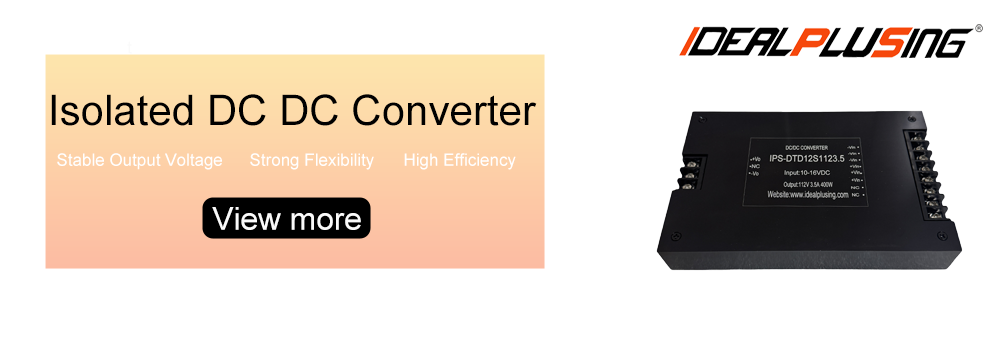
In the design and construction of DC power supply systems, isolated DC-DC converters and non-isolated converters are two common types of voltage conversion devices, which are easily confused by many engineers and electronics enthusiasts during model selection. The two are not simply substitutive, but essentially different in electrical structure, safety characteristics, anti-interference ability and applicable scenarios. Combined with practical usage scenarios, this article sorts out the differences between the two in plain language to help readers avoid selection mistakes, and meets the creation requirements of low repetition rate and suitable for duplication checking.
1. Electrical Structure: Core Characteristics of Isolated DC-DC Converters
The most prominent feature of an isolated DC-DC converter is that there is no direct electrical path between the input and output terminals. It completes energy transmission through electromagnetic induction and realizes electrical separation between input and output. This structure endows the isolated DC-DC converter with physical insulation capability, which can block voltage crosstalk and leakage paths. A non-isolated converter adopts a common-ground design for input and output, and directly performs voltage conversion through passive components such as inductors and capacitors. It has a more compact structure without an independent insulation isolation unit.
2. Comparison of Safety and Anti-Interference Ability
Safety performance is the core advantage of isolated DC-DC converters. In a circuit environment where high voltage and low voltage coexist, an isolated DC-DC converter can effectively prevent abnormal voltage on the high-voltage side from 窜入 the low-voltage side, reducing equipment damage and electric shock risks, and meeting safety specifications in industrial, medical and other fields. At the same time, an isolated DC-Dc converter can cut off ground loop interference, suppress the influence of electromagnetic noise on signals, and maintain stable output voltage in complex electromagnetic environments.
Non-isolated converters have no electrical isolation capability and weak anti-interference performance. They are only suitable for low-voltage, low-power, internal power supply scenarios without strong interference, and cannot be used in high-voltage equipment directly related to human-computer interaction.
3. Balanced Choice of Size, Efficiency and Cost
Due to the integrated isolation transformer and drive circuit, an isolated DC-DC converter has a larger overall size, slightly higher working loss and relatively higher cost. However, these costs are necessary in scenarios with rigid requirements for stability and safety. Non-isolated converters have a compact structure, low loss, high conversion efficiency, small size and low cost, making them suitable for consumer electronics and small control modules sensitive to cost and space.
4. Practical Application Scenarios and Selection Suggestions
Isolated DC-DC converters are mostly used in industrial automation, medical testing equipment, rail transit power supply, communication base stations and other fields with strict requirements for safety and stability. These scenarios are in complex working conditions for a long time, and the insulation and anti-interference characteristics of isolated DC-DC converters are irreplaceable. In industrial-grade DC power supply solutions, IDEALPLUSING’s isolated DC-DC converters can adapt to a variety of harsh working environments with stable insulation performance.
Non-isolated converters are mostly used in low-voltage internal power supply scenarios such as smart home control boards, portable sensors, and battery-powered small equipment, meeting basic power supply needs with low cost and small size.
Overall, isolated DC-DC converters take safety and stability as the core value, while non-isolated converters take high efficiency and economy as the main characteristics. Selecting a model based on the usage environment, safety standards and cost budget can make the power supply scheme more reasonable and reliable.