
In laboratory testing environments—whether involving the R&D of electronic devices, the verification of electrical performance, or product reliability testing—Variable frequency power supply consistently occupy a central position, serving as critical and indispensable testing equipment. Many wonder: why can't standard mains power supplies simply take the place of variable frequency units? The reality is that laboratory testing imposes extremely rigorous demands on power supply stability, controllability, and adaptability. The unique advantages of variable frequency power supplies precisely address the testing pain points that standard power sources fail to resolve, thereby providing a robust guarantee for the accuracy and comprehensiveness of test results.
The core requirement of laboratory testing is "precise controllability"—a factor that constitutes the fundamental difference between variable frequency power supplies and standard mains power sources. Conventional utility power comes with fixed voltage and frequency specifications, such as the 220V/50Hz standard widely used domestically, offering no flexible adjustment to match customized testing needs. Laboratory trials, nevertheless, cover an extensive range of equipment and application scenarios, each placing vastly different requirements on power parameters. When designing electronic products for export, for example, it is indispensable to replicate grid conditions across global markets—including the 230V/50Hz system adopted throughout most of Europe and the 120V/60Hz specification used in North America. Variable frequency power supports fine tuning of output voltage and frequency alike, accurately replicating real-world grid environments of target regions and guaranteeing product performance compatibility under varied operational conditions.
Superior stability inherent to Variable frequency power supplies lays an essential groundwork for credible test data. Within laboratory environments, even trivial power fluctuations can skew experimental results and may even inflict permanent damage on devices under test. Conventional grid power is easily affected by external variables including fluctuating grid loads and transmission line losses, rendering voltage instability and frequency drift almost inevitable. By comparison, variable frequency power supplies adopt sophisticated power electronic technologies to deliver highly regulated voltage and frequency output, keeping overall fluctuation strictly within ±0.5%. This effectively insulates testing procedures from grid-side disturbances. In precision electronic component testing, for instance, trivial voltage variations are enough to trigger abnormal shifts in component parameters; the steady output delivered by variable frequency power guarantees excellent repeatability and authenticity of test results, underpinning reliable product research, development and quality validation workflows.
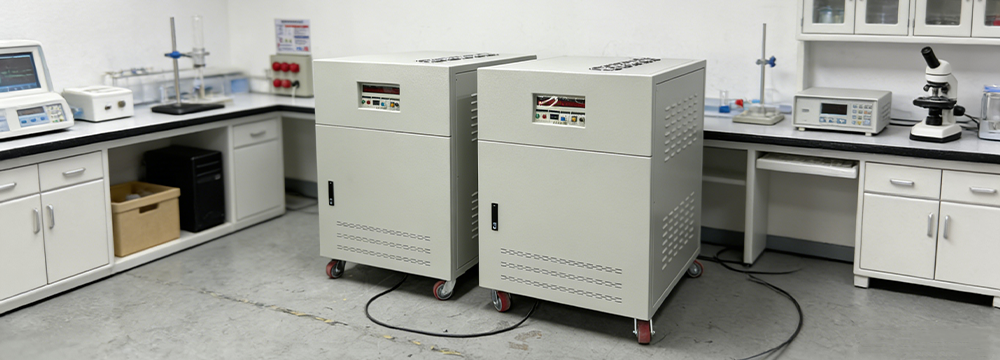
High compatibility—and the ability to adapt to a wide variety of testing scenarios—constitutes yet another major advantage that makes variable frequency power supplies indispensable. The subjects of laboratory testing are diverse, ranging from small electronic components and consumer electronics to industrial control equipment and new energy devices; consequently, the power levels, voltage ratings, and load characteristics of these various devices differ significantly. Offered by variable frequency power supplies is the flexibility to adjust output power, voltage range (typically spanning 0–300V), and frequency range (usually covering 40–60Hz, with certain high-end models extending to 0–400Hz), all tailored to the specific requirements of the device under test (DUT). Supported by these power supplies are also various load types—including pure resistive, inductive, and capacitive loads—thus accommodating a broad spectrum of testing needs, from low-power to high-power applications.
Whether the task involves aging tests for household appliances, performance testing for electric motors, or compatibility testing for new energy vehicle charging stations, tailored power solutions for every scenario are delivered by variable frequency power supplies.
Further underscoring the indispensable role of variable frequency power supplies in laboratory testing environments are their safety and intelligent functionalities. During laboratory testing—especially when the DUT is in the early R&D stage—risks such as performance instability or short circuits may arise. Equipped with multiple safety features are variable frequency power supplies, including overcurrent, overvoltage, overheating, and short-circuit protection, enabling them to cut off power instantly and safeguard both testing personnel and the DUT.
Concurrently, featured in most modern variable frequency power supplies are intelligent user interfaces, supporting functions such as parameter presets, data logging, and remote control; streamlined by these capabilities is the testing workflow, and enhanced is operational efficiency. For instance, during batch product testing, specific parameters can be preset to facilitate automated testing, thereby minimizing human error and boosting overall testing efficiency significantly.
Moreover, driven by rapid technological advancements, constantly rising are the standards for laboratory testing, prompting continuous technological upgrades in variable frequency power supplies that further expand their application scope. In emerging fields such as new energy, the Internet of Things (IoT), and artificial intelligence (AI), specific requirements regarding power supply parameters—such as waveforms and harmonic content—are imposed by many devices.
Capable of generating a variety of output waveforms—including sine, square, and triangle waves—are high-end variable frequency power supplies, while simultaneously maintaining precise control over harmonic content, thereby meeting the demands of complex testing scenarios.
In summary, by virtue of their precisely controllable output parameters, high stability, strong compatibility, and intelligent safety features, perfectly aligned with the rigorous power supply standards required in laboratory testing environments are variable frequency power supplies. Effectively resolved by them are the testing challenges that standard utility power sources cannot address. Whether for product R&D, performance verification, or quality inspection, reliable power support for testing operations is provided by variable frequency power supplies, ensuring the accuracy and comprehensiveness of test results—and thus serving as indispensable core equipment in laboratory testing environments.