
The selection must fully match the load characteristics, working environment, and actual production requirements.This paper systematically analyzes the key factors in selecting industrial-grade microwave power supplies. It aims to provide both theoretical support and practical guidance for engineers, equipment developers, and production managers.
1. Match Output Power and Voltage Parameters to Load Requirements
The primary principle of selecting a microwave power supply is to match the rated output power with the actual power demand of the magnetron and the whole equipment. Insufficient power will lead to weak microwave output, low processing efficiency and unstable working state; excessive power margin may cause energy waste, increased heat generation and higher operating cost. In addition, the working voltage range, anode current and filament power supply parameters of the magnetron must be highly compatible with the output characteristics of the power supply. During the selection phase, the power rating must be determined through careful calculation.Key factors include equipment configuration, processing throughput, cavity dimensions, and material properties.The appropriate power level should be selected for either continuous or pulse operating modes.
2. Evaluate Stability and Anti‑Interference Performance in Harsh Industrial Environments
Industrial environmental conditions such as voltage fluctuations, electromagnetic interference, dust buildup, heat and humidity can be combined. Therefore, for industrial microwave analysis, it is necessary to use high-quality fabrics. Key indicators include voltage stabilization accuracy, low ripple coefficient, fast response speed and good anti‑interference ability. High‑quality industrial microwave power supplies usually adopt closed‑loop control, stable filtering and optimized circuit design to maintain stable output under long‑term high load. In addition, several key environmental indicators determine the long‑term performance of the equipment under harsh conditions.These include a wide operating temperature range, effective moisture protection, and a high dust‑proof rating.
3. Confirm Protection Mechanisms and Safety Design
In continuous industrial production, the protection system of the power supply is related to equipment safety and personnel security. The design of modern industrial microwave systems incorporates mechanisms for protection against overvoltage, overcurrent, overheating, short circuits, phase loss, and interlocks. Thermocouple elements contribute to the thermodynamic characteristics of the system and serve to elucidate these mechanisms. It effectively prevents damage to critical components such as magnetrons, transformers and control circuits. In the selection process, users should evaluate the protection response speed, stability of action and fault handling capability. It would be even better if it supported automatic troubleshooting and fault alarm functions. These services help extend the life of the equipment and reduce operating and maintenance costs.
4. Consider Heat Dissipation Structure and Service Life
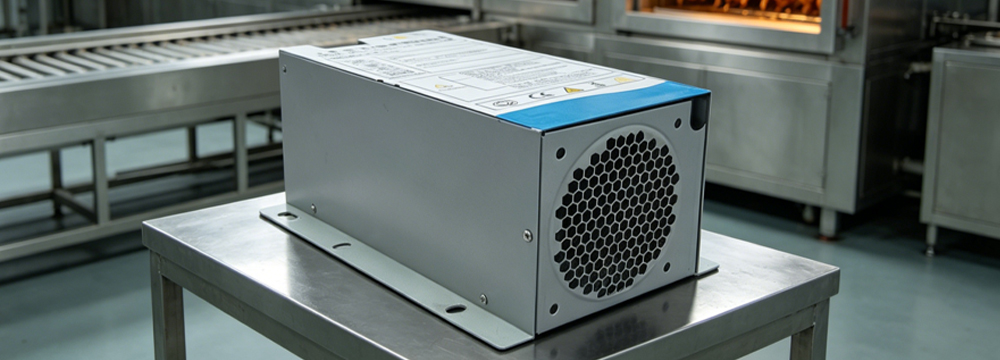
Continuous operation of microwave power supplies inevitably leads to internal heat generation. High temperatures accelerate component aging and increase the risk of failure. Well-designed small-scale industrial power grid systems employ advanced thermal management algorithms. Common solutions include improved ventilation, efficient heating systems, fan-based temperature control, and integrated water heating systems.These designs maintain stable operating temperatures and improve operational reliability.When selecting a power supply, multiple thermal indicators should be evaluated. These include heat dissipation efficiency, operating noise, service life of cooling parts, and ease of maintenance.A rational heat dissipation structure slows the aging of capacitors, transformers, and semiconductors. It extends the service life of the power supply and reduces the total cost of ownership.
5. Verify Compatibility, Controllability and Scalability
Modern industrial microwave equipment often needs to be connected with PLC, host computer, touch screen or automatic production line. Therefore, the microwave power supply should have good controllability and interface compatibility, such as analog control, digital communication, potentiometer regulation, external start‑stop control and other functions. At the same time, the scalability of the power supply should also be considered, including whether it supports power expansion, parallel operation, multi‑machine synchronization and fault feedback output. For automated production lines, standardized interfaces and stable communication capabilities can significantly improve system integration and intelligent control level.
6. Analyze Reliability, Maintenance and After‑Sales Support
Industrial equipment requires sustained and stable operation in long‑term working conditions.Therefore, the reliability and maintainability of the microwave power supply become critical evaluation criteria.In the selection process, products with mature technology, standardized manufacturing, and strict quality inspection should be given priority. At the same time, structural design that is easy to maintain, such as modular structure, quick‑plug interfaces and clear fault indication, can reduce maintenance difficulty and downtime. In addition, perfect after‑sales support, technical guidance and spare parts supply capacity are also important factors to ensure long‑term use, especially for large‑scale and continuous production scenarios.
Selecting the appropriate microwave industrial power supply is a comprehensive decision involving power parameters, stability, safety, heat dissipation, compatibility and reliability. Only by comprehensively evaluating according to the actual working conditions, load characteristics, production requirements and environmental constraints can we find the most matching solution. A high‑quality microwave power supply can not only improve the efficiency and stability of equipment, but also reduce energy consumption, extend service life and create higher economic value for industrial production. With the continuous upgrading of industrial microwave technology, the targeted and intelligent level of power supply will be further improved, providing more solid support for the development of efficient, green and intelligent manufacturing.