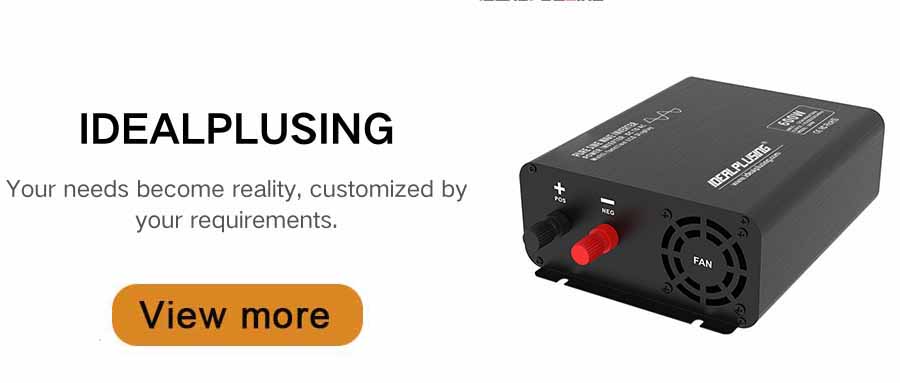
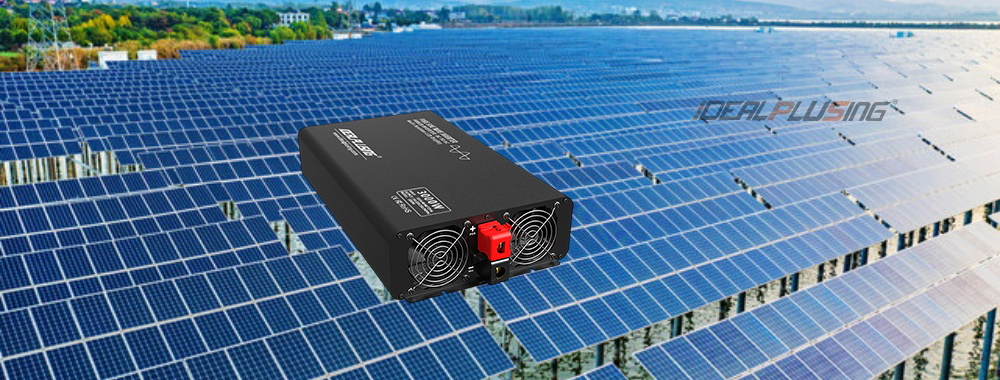
With the increasing prevalence of renewable energy, solar photovoltaic systems have become the preferred choice for many homes and businesses. In these systems, inverters play a crucial role, converting the direct current (DC) generated by solar panels into alternating current (AC) for home use or grid connection. Today, we will introduce off-grid inverters and grid-connected inverters, and discuss their working principles.
Inverter Overview
An inverter converts direct current (DC) energy (from batteries or storage batteries) into alternating current (AC) (typically 220V, 50Hz sine wave). It consists of an inverter bridge, control logic, and filter circuits. It is widely used in air conditioners, home theaters, electric grinders, power tools, sewing machines, DVDs, VCDs, computers, televisions, washing machines, range hoods, refrigerators, VCRs, massagers, fans, lighting, etc. In other countries, due to the high rate of car ownership, inverters can be used to power appliances and tools when working or traveling, connected to batteries. Car inverters that output power through the cigarette lighter socket come in power ratings from 20W, 40W, 80W, 120W to 150W. Inverters with higher power outputs need to be connected to the car battery via cables. Connecting household appliances to the power converter's output allows for the use of various electrical appliances within the car.
Grid-connected Inverters
Grid-connected inverters are generally categorized into photovoltaic grid-connected inverters, wind power grid-connected inverters, power equipment grid-connected inverters, and other power generation equipment grid-connected inverters. The biggest advantage of grid-connected inverters is their high system power and low cost.
Grid-connected inverters are typically used in large-scale photovoltaic power plant systems. Many parallel photovoltaic strings are connected to the DC input of the same centralized inverter. High-power inverters generally use three-phase IGBT power modules, while lower-power inverters use field-effect transistors. A DSP conversion controller is used to improve the quality of the generated power, making it very close to a sinusoidal current.
Off-Grid Inverters
Off-grid inverters typically employ a complete system solution comprised of modular components, consisting of manageable building blocks: the inverter, solar charge controller, automatic generator starter module, and system control board.
As the name suggests, an off-grid inverter is a system disconnected from the public power grid. The direct current (DC) generated by the solar panels is first stored in batteries, then fed into the off-grid inverter where it is converted into alternating current (AC). This AC power can be directly supplied to the load or returned to the batteries for storage. It is particularly suitable for remote areas without grid coverage, such as deserts, plateaus, and forests, providing electricity on demand anytime, anywhere.
Technical Differences
Grid-connected and off-grid inverters also differ in some technologies:
1. Synchronization Technology
Grid-connected inverters require precise synchronization technology to ensure that the output AC power is perfectly synchronized with the grid frequency and phase. Off-grid inverters do not require this synchronization because they are not connected to the grid.
2. Protection Mechanisms
Grid-connected inverters typically have more complex protection mechanisms to ensure rapid disconnection in the event of grid problems, protecting the system and user safety. Off-grid inverters require more protection mechanisms to manage energy storage systems and loads.
3. Efficiency
Grid-connected inverters are generally slightly more efficient than off-grid inverters because they do not require additional energy conversion steps. However, this difference is usually small and can be compensated for by high-quality inverter design.
In general, inverters are widely used in various applications. The difference between off-grid and grid-connected inverters is that grid-connected inverters need to be connected to the power grid, while off-grid inverters do not need to be connected to the power grid.
IDEALPLUISNG Power Expert:
We focus on the research and development, sales and services in the fields of DC-DC power modules, AC-DC rectifier modules, DC-AC inverters, AC power supplies, DC power supplies, LED power supplies, chargers, rectifier systems, etc., providing personalized, efficient, reliable and cost-effective power solutions for all walks of life.
Thank you for considering our services.