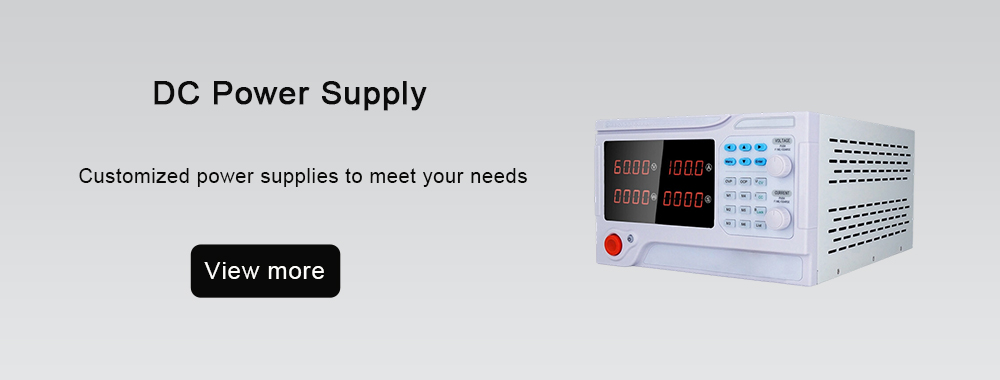
There are many types of regulated DC power supplies, but based on different application requirements, they can be categorized into power supplies with different characteristics. Regulated power supplies are primarily designed for powering low-voltage electrical appliances and typically feature simple functions, high output power, relatively high output current (several amperes to tens of amperes), and the ability to power multiple devices simultaneously.
Adjustable DC Regulated Power Supplies
The most significant feature of adjustable DC regulated power supplies is their adjustable output voltage. Because the voltage is adjustable, they have a wide range of applications and are widely used in laboratories and maintenance settings. Therefore, they are also known as "maintenance power supplies" or "experimental power supplies." In practice, products used in laboratory and maintenance applications also offer other convenient and practical functions, such as adjustable current limiting and tracking functions. The current limiting function is even more practical, allowing the maximum current output of the regulated power supply to be set.
When the current output exceeds the set value, the voltage drops, but the current no longer increases, as if a constant current mode has been input. Some power supplies provide overcurrent protection. When the current exceeds a specified value, it will enter a protective state, shutting down the output and restarting the power supply to restore the output. During experimental and maintenance work, short circuits may occur due to operational errors or circuit faults. By using current limiting, not only can the power supply itself be protected, but also the components in the circuit can be protected from the effects of large currents. Generally, the current of commercially available regulated DC power supplies is not large, with an output current of 1-3A, which can meet the maintenance and experimental needs of ordinary digital products and mobile communication products.
Programmable DC Power Supply
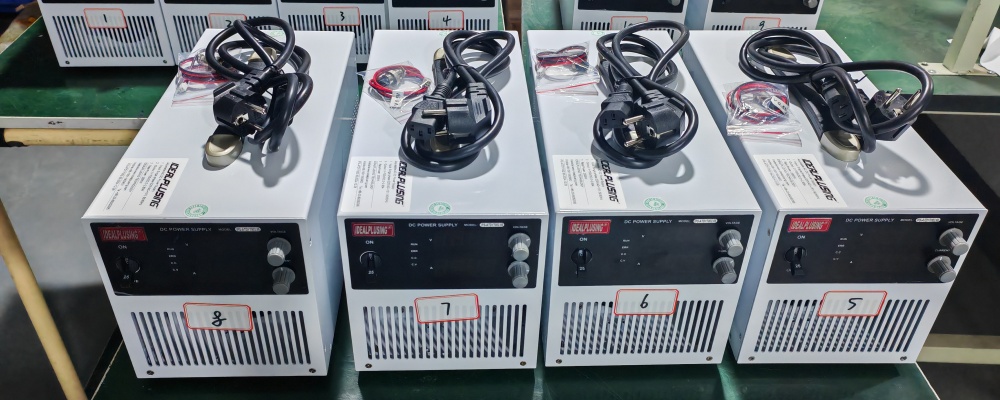
A programmable power supply is an adjustable regulated power supply digitally controlled by a microcontroller. Its settings can be saved for later use. Programmable power supplies have many parameters, such as: basic voltage setting, power limit setting, overcurrent setting, and advanced overvoltage setting. Typically, programmable power supplies have high setting resolution and can use a numeric keypad to input voltage and current parameters. Mid-to-high-end programmable power supplies have very low voltage drift and are mainly used for research purposes. A standard reference voltage power supply is a special type of regulated power supply whose function and internal circuitry differ from conventional regulated power supplies. It is used to provide a reference voltage for calibrating various voltage measuring devices (voltmeters, multimeters). The load capacity itself is very low, but the voltage accuracy is very high and the drift is also very low.
Switching Power Supplies vs. Linear Power Supplies
Currently, there are two types of circuits for achieving DC voltage stabilization: traditional linear power supplies, which are equipped with a transformer as the core, featuring a step-down circuit and additional voltage stabilization circuitry; and conventional switching power supplies, which consist of electronic circuitry and operate in a switching state. Both types of power supplies have their advantages and disadvantages.
The advantages of linear power supplies are easy ripple control, simple circuitry, and ease of maintenance. The disadvantages are complex size, the need for large-capacity transformers and capacitors, and relatively low conversion efficiency.
The advantages of switching power supplies are small size, light weight, and high conversion efficiency, but they require expensive transformers or large capacitors. The disadvantages are a more complex circuit structure, difficult maintenance, inevitable interference with the switching frequency, and more difficult ripple control. Currently, due to the maturity of switching power supply technology and the stable increase in the price of copper (manufacturing transformers requires more copper wire), the cost advantage of traditional linear power supplies is diminishing, while the cost advantage of high-current output switching power supplies is becoming increasingly apparent.
In general, there are many types of regulated DC power supplies. Based on different application requirements, they can be broadly classified into adjustable DC regulated power supplies, programmable DC power supplies, switching power supplies, and linear power supplies. Each type of power supply has its own characteristics and advantages, and you can choose according to your own needs when purchasing.
IDEALPLUSING Power Expert:
We focus on the research and development, sales and services in the fields of DC-DC power modules, AC-DC rectifier modules, DC-AC inverters, AC power supplies, DC power supplies, LED power supplies, chargers, rectifier systems, etc., providing personalized, efficient, reliable and cost-effective power solutions for all walks of life.
Thank you for considering our services.