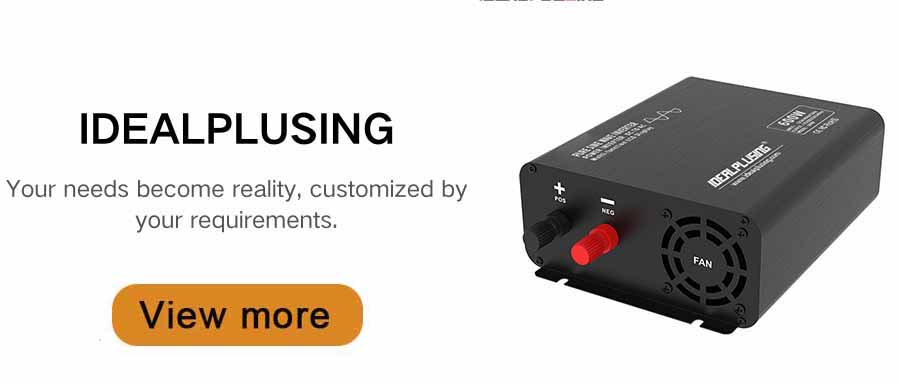
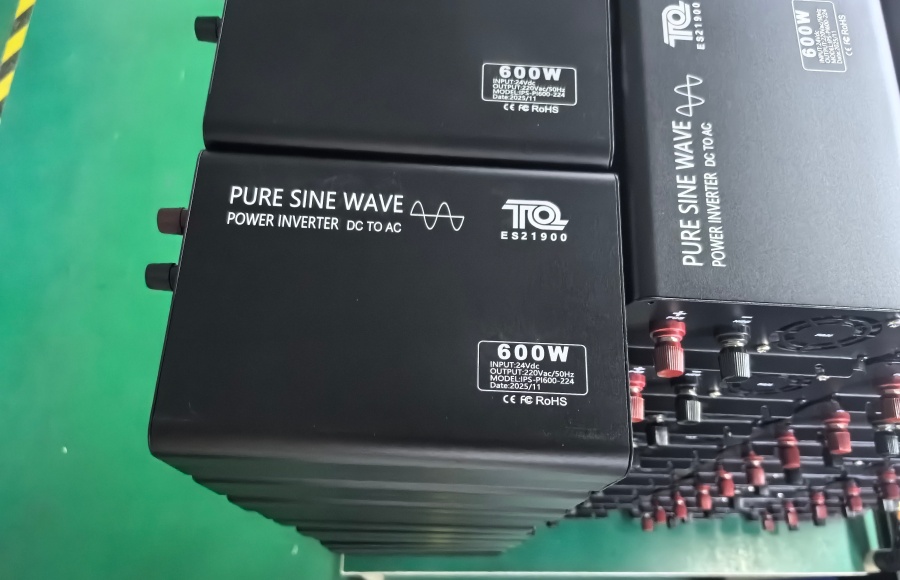
A Sine wave inverter is a converter that transforms direct current (DC) into alternating current (AC). It does this by controlling the switching on and off of semiconductor power switching devices (such as SCRs, GTOs, GTRs, IGBTs, and power MOSFETs). The circuit that controls the switching on and off of these power switches is the inverter's control circuit. This control circuit outputs specific voltage pulses, causing the power switches in the power conversion circuit to turn on and off according to a certain pattern. At this time, the output of the main power circuit has a specific harmonic combination, which is then filtered by a filter circuit to obtain the desired voltage waveform.
Input Circuit
The inverter's input is typically direct current (DC) (or DC obtained by rectifying and filtering AC mains power). This DC power includes DC grid power, batteries, photovoltaic cells, and DC power obtained from other sources. Usually, this power cannot be directly used as the inverter's input voltage; instead, it must pass through a filter circuit and an EMC circuit before being used as the inverter's input.
Inverter Main Circuit
The inverter main circuit is a power conversion circuit composed of power switching devices. There are many structural forms of the main circuit, and the form varies depending on different input and output conditions. Each power conversion circuit has its advantages and disadvantages. In practical design, the most suitable circuit topology should be considered as the main circuit structure.
Control Circuit
The control circuit generates one or more sets of pulse voltages according to the inverter output requirements, using certain control techniques. These pulses are then driven by the drive circuit to the power switching transistors, causing them to turn on or off in a specified sequence, ultimately resulting in the required voltage waveform at the main circuit output. The control circuit is crucial to the inverter system; its performance directly determines the quality of the inverter's output voltage waveform.
Output Circuit
The output circuit generally includes an output filter circuit and an EMC circuit. If the output is DC, a rectifier circuit should be added afterward. For inverters with isolated outputs, an isolation transformer should also be included before the output circuit. Based on whether a voltage regulator circuit is required at the output, output circuits can be divided into open-loop and closed-loop control. In an open-loop system, the output is determined solely by the control circuit, while in a closed-loop system, the output is also affected by the feedback loop, making the output more stable.
Auxiliary Power Supply
Certain parts or chips in the control circuit and input/output circuits have specific input voltage requirements. An auxiliary power supply can meet these specific voltage demands. Typically, an auxiliary power supply consists of one or more DC-DC converters. For AC input applications, the auxiliary power supply is a combination of rectified voltage and a DC-DC converter.
Protection Circuit
Protection circuits typically include input overvoltage and undervoltage protection, output overvoltage and undervoltage protection, overload protection, overcurrent protection, and short-circuit protection. Inverters operating in specific environments may also have additional protections, such as temperature protection for very low or very high temperatures, pressure protection for pressure changes, and humidity protection for humid environments.
IDEALPLUISNG Power Expert:
We focus on the research and development, sales and services in the fields of DC-DC power modules, AC-DC rectifier modules, DC-AC inverters, AC power supplies, DC power supplies, LED power supplies, chargers, rectifier systems, etc., providing personalized, efficient, reliable and cost-effective power solutions for all walks of life.
Thank you for considering our services.