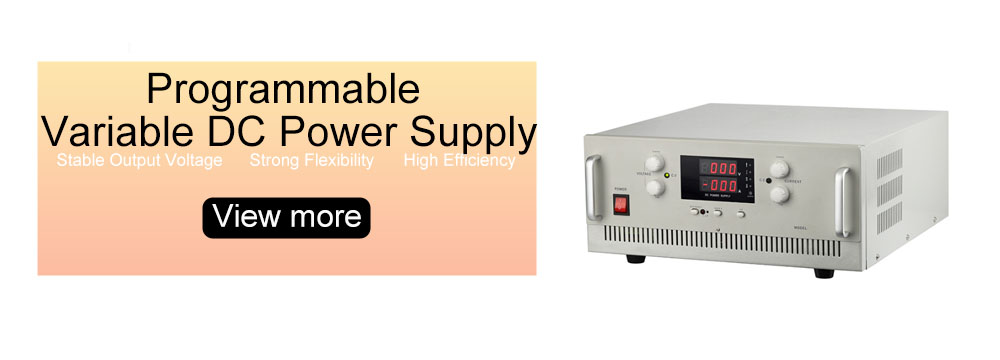
In the precision testing scenarios of laboratories, the performance of a high-precision adjustable power supply directly affects the reliability of experimental data. Many researchers often get lost in a maze of parameters when selecting models, struggling not only with whether the 0.1mV-level precision is genuine but also with how remote control can adapt to experimental systems. This article starts from core needs, breaks down niche and practical selection logic, and incorporates problem-solving skills.
1. Core Judgment Dimensions for 0.1mV Precision
The precision of a high-precision adjustable power supply is not merely about parameter labels; it is necessary to focus on stability in practical applications. Prioritize models with full-digital design, as their 24Bit AD readback function can accurately capture output changes and avoid false labeling errors. At the same time, confirm whether it supports the SENSE remote compensation function, which can offset the impact of wire voltage drop. Especially in low-voltage testing, it ensures the load end truly obtains the set voltage—this is a core advantage of many niche high-quality adjustable power supplies. Calibration convenience should not be overlooked either; models that support panel fine-tuning without professional tools can reduce precision drift after long-term use.

2. Key Points for Troubleshooting Common Issues of Adjustable Power Supplies
In experiments, adjustable power supplies are prone to problems such as voltage fluctuations and decreased load capacity. If the displayed voltage does not match the measured value, first check if the compensation function is enabled, then use a multimeter for comparative calibration to rule out loose wiring hazards. If ripple interference occurs, it is likely due to insufficient power supply filtering performance. Priority can be given to models adopting SiC design, whose low-ripple characteristics are more suitable for precision component testing. When overheating protection is frequently triggered, clean the vents and check if the load exceeds the rated power to avoid affecting the service life of the adjustable power supply due to long-term overload.

3. Adaptation Logic for Remote Control
In laboratory automated testing, the remote control of adjustable power supplies needs to balance compatibility and response speed. Prioritize models supporting RS-485 and SCPI protocols, as their interface stability is stronger and they are compatible with most upper computer systems. Pay attention to confirming the communication response time; models with ≤20ms can meet the needs of dynamic testing. For example, some models from IDEALPLUSING perform well in remote control adaptability, integrating into experimental systems without complex configurations. In addition, adjustable power supplies supporting multiple sets of parameter memory can reduce repeated settings and improve testing efficiency.

There is no need to blindly pursue high-end configurations during selection; comprehensive judgment should be based on the load characteristics, precision requirements, and control methods of the experimental scenario. A high-quality laboratory adjustable power supply should achieve a balance between precision stability, problem fault tolerance, and expandability, becoming a reliable backing for precision experiments.