
Introduction
These days, precision gear’s everywhere—electronics factories making circuit boards, medical labs running diagnostic machines, even aerospace shops testing parts. But here’s the thing I’ve noticed from talking to clients: most people don’t think about the power that keeps these machines working right. You can have the best precision equipment, but if the power’s off even a little? It’s useless. That’s why variable-frequency power supplies matter so much. I’m gonna walk through what they are, how they work (no jargon, just how I explain it to factory guys), and why they’re a must if you’re dealing with sensitive machines.
What is a Variable-Frequency Power Supply?
Let me start simple—forget the tech terms first. A variable-frequency power supply is just a power source you can tweak. Regular wall power? It’s set in stone. Where I’m at, it’s 50Hz, 220V—never changes. But if you’re testing a part that’s supposed to work in the US (where it’s 60Hz, 110V), that fixed power won’t cut it.
I had a client last month—they make small sensors for cars. They got a batch of parts designed for the European market (50Hz) but needed to test them for a US customer. Their regular power kept giving wrong test results until they used this supply. Just dialed it to 60Hz, 110V, and boom—tests were accurate. It’s basically a “power customizer” for machines that need specific voltage/frequency to work.
How Does a Variable-Frequency Power Supply Work?
I’ll break this down like I did for that client’s engineer who hated tech talk. It’s three main steps, but I’ll keep it real:
First, it takes the grid power—you know, the AC from the power lines that’s always the same. But first, it needs to turn that AC into DC. Why? Because AC bounces back and forth, DC flows steady. The part that does this? A rectifier. Think of it like a funnel—takes the wobbly AC, squeezes it into smooth DC, like turning a messy stream into a straight hose.
Then comes the important part: the inverter. This is where you get the “variable” part. The inverter takes that DC and turns it back into AC—but now you can adjust it. How? It flips the DC on and off super fast. If you flip it 60 times a second, you get 60Hz; 50 times, 50Hz. And how hard you flip it? That sets the voltage. I told the engineer: “It’s like tapping a water hose—tap fast for high frequency, harder for more pressure (voltage).”
Last, there’s a filter. You don’t want any little bumps in the power—precision machines hate that. The filter smooths out the AC, so what goes to the machine is steady, no spikes or dips. That’s the part that saved another client’s medical scanner—without the filter, the screen kept glitching during tests.

How Variable-Frequency Power Supplies Protect Precision Equipment During Testing
Testing’s where I see most mistakes. I had a factory last year testing GE medical CT scanners—they used regular grid power, and half the tests showed “errors” that weren’t even there. Turned out the grid had tiny frequency jumps (like 50.2Hz to 49.8Hz) that the scanner picked up.
With a variable-frequency supply? You set it to exactly what the machine needs—for that CT scanner, it was 50Hz, 230V. No more jumps, no more false errors. And here’s another thing: you can simulate bad power. A client making industrial sensors needed to test how their parts hold up in places with unstable grids (like remote factories). We set the supply to dip to 45Hz, spike to 55Hz—just like real-world conditions. They found a flaw in the sensor’s power circuit and fixed it before shipping. Saved them from a huge recall.
Ensuring Smooth Operation of Precision Equipment
Even after testing, you can’t just plug precision gear into the grid. I was at a semiconductor plant in Shanghai last quarter—they make microchips for phones. Their etching machine is extremely sensitive; a voltage spike of 0.1V can destroy 1,000 chips at once.
They use two variable-frequency supplies: one for the etcher, one for the cooling system. The supplies take the grid’s wobbly power, fix it to 50Hz, 380V exactly, and send it to the machines. In six months, they haven’t had a single batch ruined by power issues. Compare that to before—they lost 2 batches a month. That’s a huge savings.
Everyday stuff like fridges don’t care about small power changes, but precision gear? It’s like a race car—needs exactly the right fuel, no cheap stuff. The supply is the “fuel filter” for power.
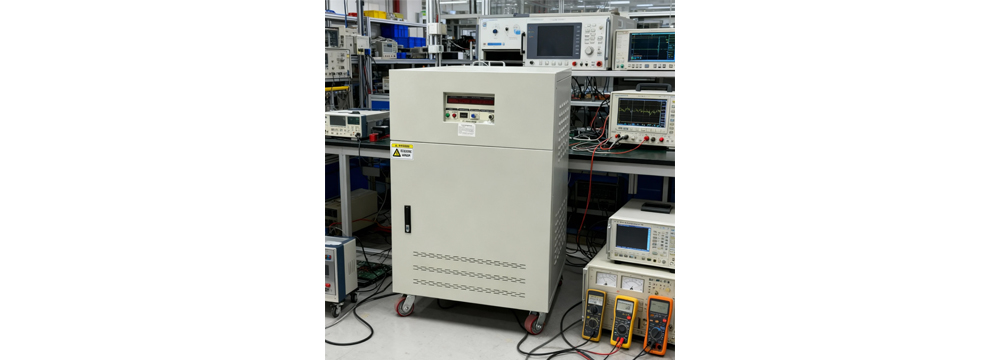
Why Variable-Frequency Power Supplies Are a Must for Industries Using Precision Equipment
Here’s the bottom line for businesses: it’s not a “nice to have”—it’s a cost saver. Let’s do quick math: a mid-range variable-frequency supply costs around
2,000.Abatchofruinedmicrochips?
50,000. A recalled sensor shipment? $100,000. It’s a no-brainer.
And they’re not just for big factories. A small lab testing DNA sequencers? They use a compact supply that fits on a table. I helped a startup last month—they make portable ultrasound machines. They use a small supply
Share our interesting knowledge and stories on social media