
Adjustable DC power supplies are common tools for electronic beginners and equipment maintenance. However, beginners often cause problems such as component burnout and power supply failures due to irregular operations. In fact, the core of safe use lies in "understanding equipment characteristics and following operating logic", combined with basic troubleshooting skills, which can avoid most risks. Below, we will guide you through the entry process step by step from three aspects: practical operation, safety details, and problem handling.
1. Before Power-On: 2 Core Checks to Block Safety Loopholes
Pre-use inspection is crucial to avoid accidents, and many beginners skip this step leading to failures. First, verify the input voltage range of the adjustable DC power supply to ensure it matches the mains power (220V or 110V). If the range is incorrect, the internal rectifier module of the power supply may be burned out instantly when turned on. Second, check the output interface to see if the terminals are oxidized or loose. If there is rust, clean it with alcohol. Poor contact can cause heating and sparking after power-on, affecting use safety.
2. Wiring and Parameter Adjustment: Slow Operation + Follow Rules to Avoid Misoperation Risks
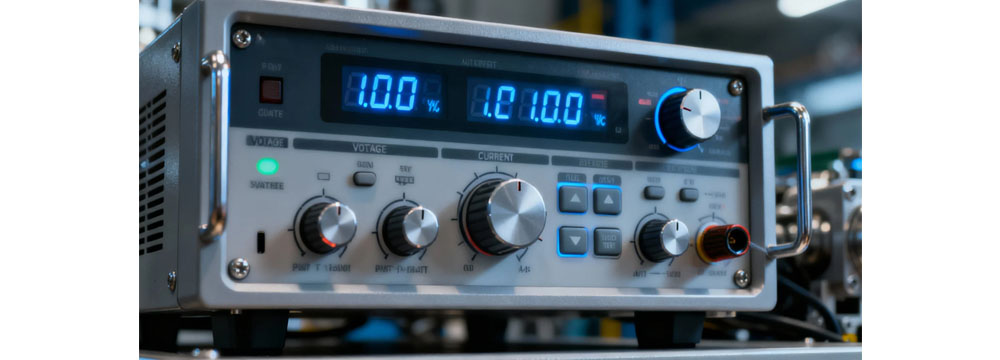
Wiring must strictly follow the sequence of "connect the load first, then turn on the power supply". The red terminal connects to the positive pole of the load, and the black terminal connects to the negative pole. Reverse connection is strictly prohibited—especially for polarity-sensitive components such as diodes and sensors, which may be directly damaged by reverse connection. After wiring, be sure to recheck the polarity and turn on the power switch only after confirmation.
When adjusting parameters, "proceed step by step": first turn the voltage and current knobs to zero, then set the overvoltage and overcurrent protection thresholds according to the load requirements (it is recommended to be 10% higher than the actual demand), and finally slowly increase the voltage and current. For example, the adjustable DC power supplies from IDEALPLUSING are equipped with a parameter fine-tuning knob and an anti-misoperation lock function, which can accurately control output changes and reduce the probability of operational errors for beginners.

3. During Use + Troubleshooting: How to Handle Abnormalities
Always pay attention to the power supply status during use. If the protection light is on, the body becomes hot, or the fan makes abnormal noise, turn off the power immediately for inspection. Common faults and solutions: First, no output after power-on—check if the power cord is plugged in tightly, the fuse is blown, and then troubleshoot if the load is short-circuited. Second, unstable output voltage—this is mostly due to poor load contact or blocked power supply heat dissipation. You can turn off the power to reconnect the load and clean the dust in the heat dissipation holes. Third, frequent overcurrent protection triggering—this indicates that the set current is lower than the actual load demand. You need to appropriately increase the threshold or check if the load has an implicit short circuit.
After use, follow the sequence of "turn off the power first, then disconnect the wiring", and reset all knobs to zero for convenient use next time. Beginners do not need to rush to explore complex functions. First, master the basic specifications of "verifying voltage, correct wiring, and slow parameter adjustment", and then you can give full play to the practical value of the adjustable DC power supply under safe conditions.