
Many beginners of adjustable DC power supplies often wonder: what is the switching logic between constant voltage (CV) and constant current (CC) modes? Which one truly dominates during output, voltage or current? In fact, there’s no need to memorize theoretical formulas. A set of simple practical experiments can turn abstract principles into straightforward ones, which is also the core foundation for flexibly mastering adjustable DC power supplies. Below, we’ll help you figure out the "dominance" of the two modes through down-to-earth experimental steps.
1. Experiment Preparation: 3 Basic Equipment, Accessible to Beginners
No complex devices are needed for the experiment; just prepare these three items: a 5-ohm 5W high-power resistor (to prevent low-power resistors from fusing due to overload), an adjustable DC power supply supporting dual constant voltage/constant current modes, and an ordinary multimeter. When choosing a power supply, you can prioritize models with clear mode
identification and smooth adjustment feel, such as the adjustable DC power supply from IDEALPLUSING, which provides clear feedback for mode switching and can reduce the probability of misoperations by beginners. Before the experiment, check if the power supply’s output terminals are oxidized or rusted and if the multimeter’s test leads are in good contact. These small details will affect data accuracy; if contact is poor, clean with alcohol or replace the test leads in a timely manner.
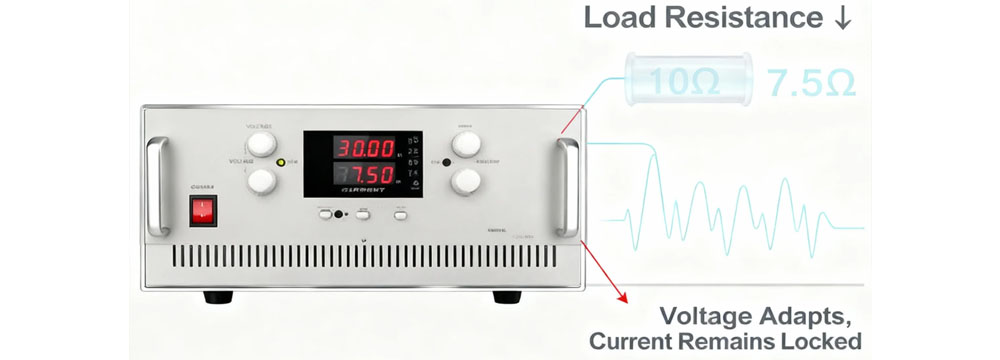
2. Constant Voltage Mode: Voltage "Dominates", Current Adapts to Load
First, switch the adjustable DC power supply to constant voltage mode, set the output voltage to 5V, and adjust the current limit to 1A (higher than the theoretical working current of the resistor to avoid premature intervention of current limiting). After connecting the 5-ohm resistor to the circuit, measure with a multimeter. You’ll find that the voltage displayed by the power supply is stable at 5V, and the current is about 1A, which fully matches the calculation result of Ohm’s Law.
Then replace the resistor with a 10-ohm one. When measuring again, you’ll find that the voltage still remains stable at 5V, while the current drops to 0.5A. This indicates that in constant voltage mode, voltage is the "boss". The power supply will automatically adapt to changes in load resistance and adjust the current to maintain voltage stability, with the current always "adapting" to the load. If there is obvious voltage fluctuation during the experiment, it is likely that the power supply’s ripple exceeds the standard or the resistor contact is poor. You can reinsert the load and calibrate the power supply if necessary.
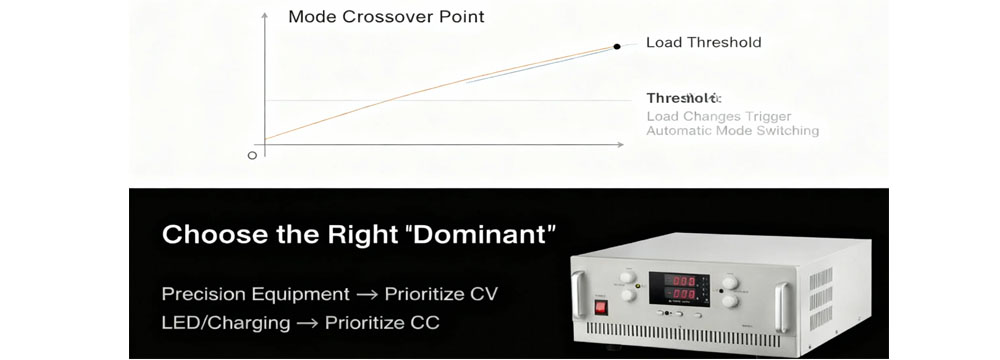
3. Constant Current Mode: Current "Guides", Voltage Adapts to Load
After switching to constant current mode, set the current to 0.5A and adjust the voltage limit to 10V (higher than the actual required voltage to reserve sufficient redundancy). After connecting the 5-ohm resistor for measurement, the current is stably locked at 0.5A, and the voltage is about 2.5V.
Key test step: Briefly short-circuit the positive and negative output wires of the power supply (be sure to operate quickly, do not short-circuit for a long time to prevent damage to the power supply due to overheating). At this time, the multimeter shows that the voltage drops to 0V instantly, but the current still remains firmly at 0.5A. Obviously, in constant current mode, current is the "boss". The power supply will automatically adjust the voltage to match the load, ensuring constant current, and the voltage fully adapts to changes in resistance. If the current cannot be stabilized during the experiment, check if the constant current threshold setting is accurate or if the power supply has triggered a protection mechanism due to overload.
The core logic of the two modes is actually very simple: constant voltage mode means voltage "has the final say", prioritizing voltage stability; constant current mode means current "guides the direction", prioritizing current stability. After understanding this rule, beginners can flexibly switch according to scenarios—use constant voltage for electronic circuit debugging, and constant current for battery charging and LED driving, easily exerting the practical value of the adjustable DC power supply.