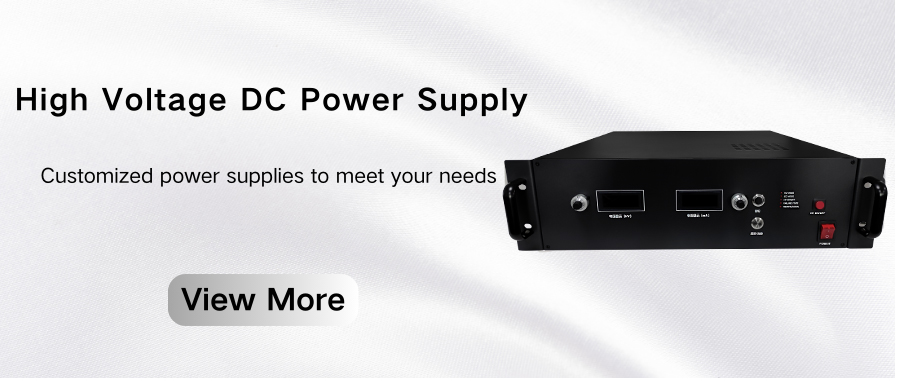
In industrial production and scientific research, high-voltage power supplies, as power supply equipment, directly affect the operating efficiency of various precision instruments and large-scale equipment. Positive and negative high-voltage power supplies, as important members of the high-voltage power supply family, although both belong to the high-voltage power supply category, have significant differences in working principles and application scenarios due to their polarity differences. Below, we will explain these differences in detail.
Differences in Working Principles
The function of a high-voltage power supply is to convert low-voltage direct current or alternating current into stable high-voltage electrical energy. The fundamental difference between positive and negative high-voltage power supplies lies in the polarity setting of the output voltage. A positive high-voltage power supply has an output terminal voltage higher than the ground potential, with current flowing out from the positive electrode of the power supply, passing through the load, and returning to the negative electrode to form a forward power supply loop. Its design focus is on maintaining the stability and anti-interference capability of high-potential output. In contrast, a negative high-voltage power supply has an output terminal voltage lower than the ground potential, with a current direction opposite to that of the positive high-voltage power supply. It outputs high-voltage electrical energy through the negative electrode, requiring emphasis on solving insulation protection and ripple control issues at low potentials. Both need to meet the basic technical requirements of high-voltage power supplies, namely the accuracy of high-voltage output and the reliability of continuous operation.
Performance Differences
In terms of performance, positive and negative high-voltage power supplies show different emphases on high-voltage power supply indicators. The load compatibility of positive high-voltage power supplies is more geared towards equipment requiring forward electric field drive, such as electrostatic adsorption devices. Their ripple coefficient is controlled at a low level to avoid the impact of electric field fluctuations on the operation. Negative high-voltage power supplies have advantages in reverse bias applications; the negative stability of the output voltage directly determines the operating accuracy of the equipment. For example, in electron microscopes, the smoothness of the negative high-voltage power supply output affects the imaging quality. It is worth mentioning that IDEALPLUSING's high-voltage power supply series achieves excellent parameter control in both positive and negative polarity products, adapting to multiple application scenarios.
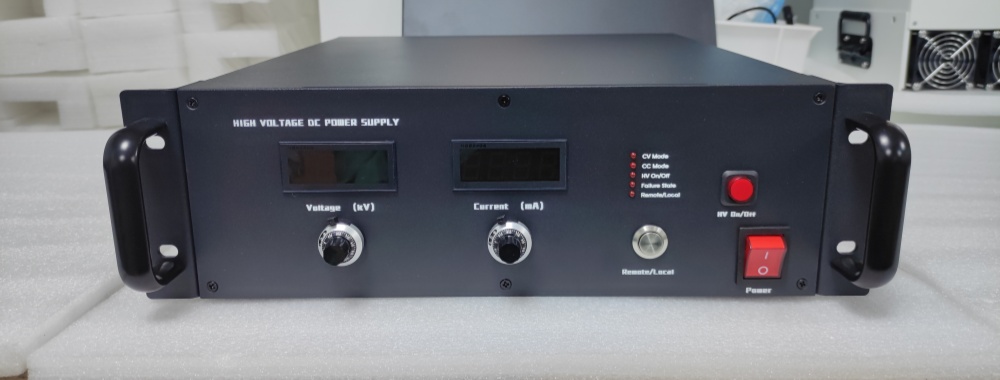
Differences in Application Scenarios
Positive high-voltage power supplies are mostly used in scenarios requiring forward high-voltage drive, such as electrostatic spraying, ion generators, and laser equipment. In these scenarios, positive high-voltage can effectively achieve the polarization of substances or the directional transmission of energy. Negative high-voltage power supplies are widely used in fields such as semiconductor manufacturing, electron beam welding, and cathode ray tubes. For example, in semiconductor etching processes, the reverse electric field provided by a negative high-voltage power supply can precisely control the trajectory of electrons. Whether positive or negative, the application of high-voltage power supplies is closely tied to the core industry requirements for high-voltage power: stability, efficiency, and safety. The choice of polarity depends entirely on the working principle and application scenario of the equipment.
The key to choosing between a positive or negative high-voltage power supply lies in clearly understanding the voltage polarity requirements of the equipment and the actual application scenario. As important branches of high-voltage power supplies, both play irreplaceable roles in their respective fields, and high-quality high-voltage power supply products, such as the IDEALPLUSING series, can provide reliable power protection for various types of equipment.
IDEALPLUISNG Power Expert:
We focus on the research and development, sales and services in the fields of DC-DC power modules, AC-DC rectifier modules, DC-AC inverters, AC power supplies, DC power supplies, LED power supplies, chargers, rectifier systems, etc., providing personalized, efficient, reliable and cost-effective power solutions for all walks of life.
Thank you for considering our services.