
Within the sectors of electronic component fabrication, power source fabrication, motor R&D and household appliance verification trials, streamlined test and burn-in workflows are indispensable to guarantee goods’ dependability, operational performance and sustained long-run operational stability.
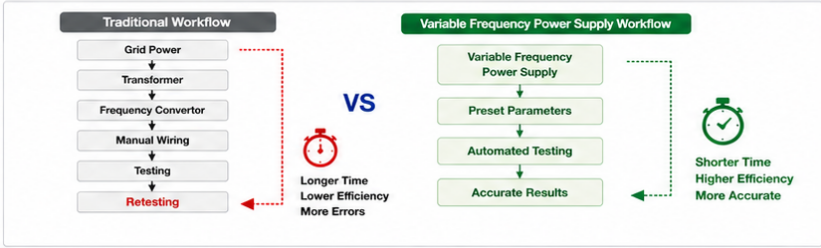
Even so, a large number of production enterprises continue adopting mains electricity with fixed frequency parameters. Such power input lacks operational adaptability and poses obstacles to replicating practical on-site working environments, which frequently prolongs test durations, triggers redundant repeated readings and generates inconsistent test datasets.
Frequency-convertible power supplies serve as a viable workaround. Featuring tunable voltage and frequency output, distortion-free waveform delivery, rapid dynamic reaction as well as automatic regulation functions, these devices assist manufacturers in cutting down test durations, boosting measuring precision and lifting overall throughput of burn-in production lines.
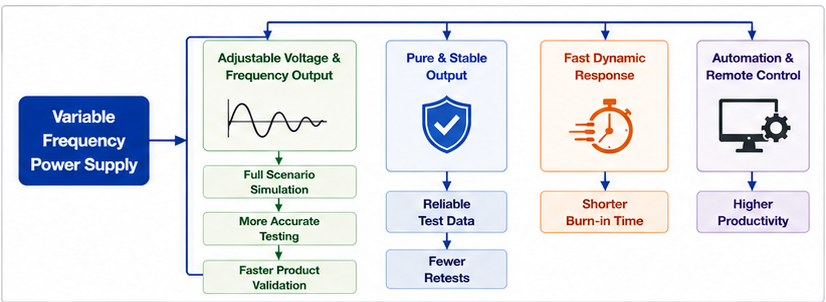
1. Replicate Practical Working Environments via Tunable Voltage & Frequency Settings
Recreating the authentic power supply scenarios products face after market launch stands out as a high-efficiency approach to elevate testing productivity.
Numerous finished goods are required to function compatibly with divergent national power grid specifications, as illustrated below:
·Export-oriented domestic appliances need compatibility with both 50Hz and 60Hz power grids;
·Switching power supplies have to endure drastic swings in input voltage;
·Electric motors demand functional certification under varying operational frequency setups.
Variable-frequency power units support uninterrupted fine-tuning of output voltage and frequency. Manufacturers can therefore mimic worldwide grid standards, voltage drift circumstances and anomalous power fault states without installing extra voltage transformers or standalone frequency changers.
Thanks to this versatile characteristic, engineering technicians are able to finish multiple conformity assessments and property verifications relying on just one unit, drastically cutting equipment preparation hours and speeding up new product certification processes.
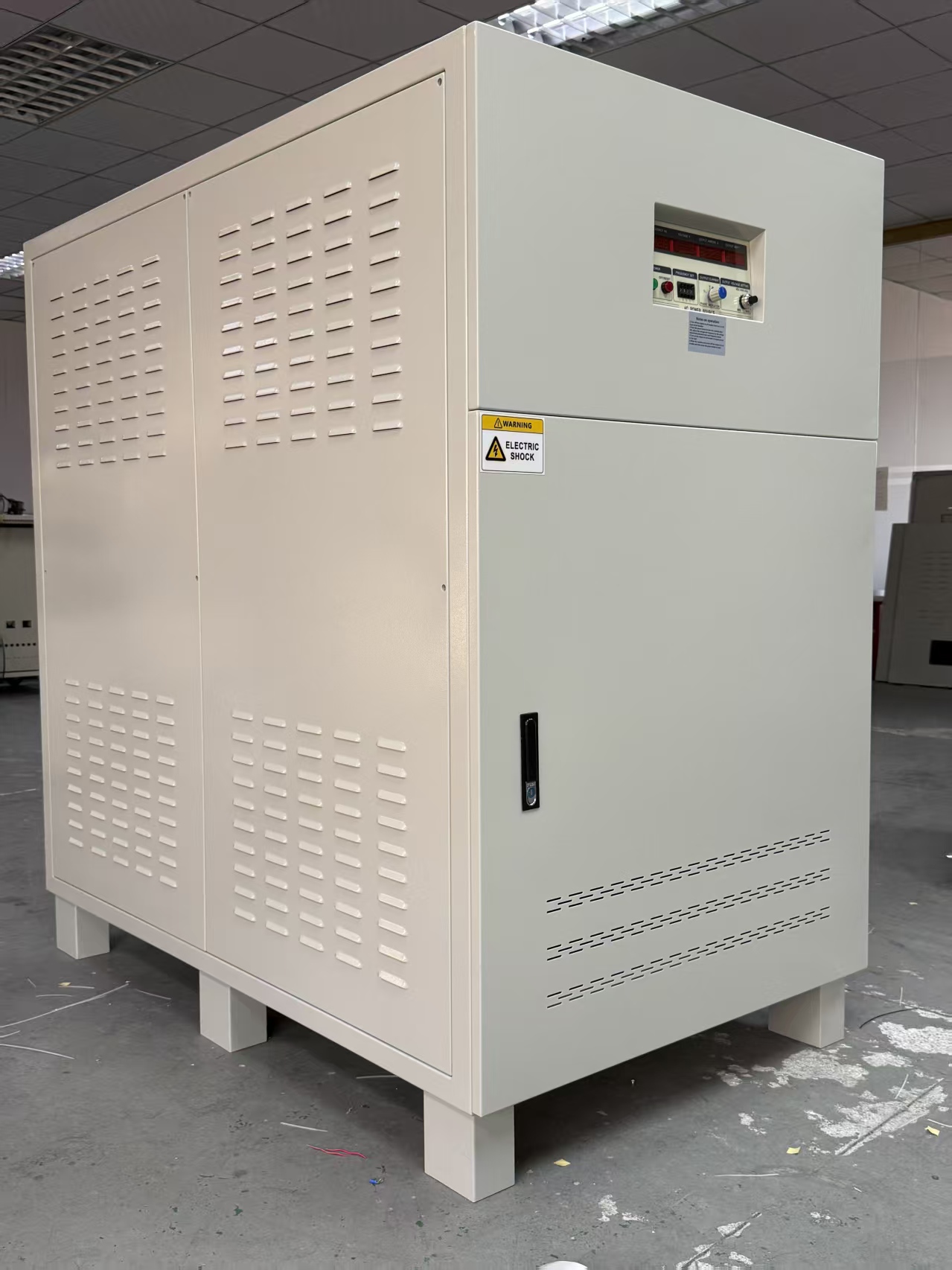
2. Enhance Measurement Precision Through Consistent, Low-distortion Power Output
Trustworthy test outcomes hinge on steady power feed for testing equipment.
Regular municipal grid power commonly carries harmonic interference, voltage drift and instantaneous electrical spikes, which impair measuring precision and force repeated round of tests.
Variable frequency power equipment adopts sophisticated AC-DC-AC conversion architecture paired with closed-loop feedback regulation and dedicated filter modules to produce the following output merits:
·Distortionless sine wave power supply
·High-precision voltage regulation
·Accurate frequency calibration
·Ultra-low total harmonic distortion (THD)
By establishing a uniform, controllable power testing environment, both testing instruments and specimen products run under standardized operating parameters. This strengthens the repeatability of collected test data and eliminates superfluous re-testing work.
3. Reduce Aging Time Through Fast Dynamic Response
Aging and burn-in testing often require products to operate under rapidly changing load conditions.
Traditional power sources may respond slowly to load variations, extending testing cycles and reducing productivity.
Variable frequency power supplies feature millisecond-level response speeds that allow them to quickly adapt to changing load requirements. This capability supports:
·Load cycling tests
·Voltage fluctuation simulations
·Startup and shutdown testing
·Stress and endurance testing
Faster power adjustment enables more test scenarios to be completed within a shorter period, helping manufacturers verify product reliability while increasing throughput.
4. Automate Testing Processes to Increase Productivity
Automation is becoming a key factor in modern testing and aging systems.
Most industrial variable frequency power supplies support communication interfaces that allow integration with:
·PLC systems
·Industrial computers
·Automated test equipment (ATE)
·Production management systems
Once test parameters such as voltage, frequency, duration, and cycle sequences are programmed, the entire testing process can run automatically without manual intervention.
This reduces labor requirements, minimizes operational errors, and enables continuous 24/7 testing, significantly improving production efficiency.
5. Use One Power Source for Multiple Product Types
Testing facilities often need to evaluate a wide variety of products, including:
·Switching power supplies
·Household appliances
·Electric motors
·PCB assemblies
·Electronic components
A high-performance variable frequency power supply can handle resistive, inductive, capacitive, and nonlinear loads, allowing a single system to support multiple testing applications.
This versatility reduces equipment investment, simplifies laboratory management, and improves overall equipment utilization.
Improving testing and aging efficiency is not simply about speeding up the process—it requires accurate simulation, stable power delivery, rapid response, and intelligent automation.
By using a variable frequency power supply, manufacturers can:
·Shorten testing and burn-in cycles
·Improve measurement accuracy
·Simulate a wider range of operating conditions
·Reduce manual intervention
·Increase production throughput
As product quality requirements continue to rise, variable frequency power supplies have become an essential tool for building faster, more reliable, and more efficient testing and aging systems.
If you are also interested in learning more, you are welcome to contact us.