Introduction
Within the technical paradigms of contemporary industrial automation, automated guided vehicles (AGVs), advanced robotics, and telecommunication infrastructures, the quantitative demand for localized power delivery architectures is experiencing an exponential escalation. Consequently, the structural optimization of point-of-load power networks has become a critical focal point in modern power electronics design. Although a 24V DC bus configuration historically persists as the legacy baseline standard for low-power control logic and sensor distribution, transitioning toward a higher-potential 48V DC bus topology has manifested as an absolute engineering imperative. This strategic voltage elevation is indispensable to adequately energize high-capacity loads, such as heavy-duty servo motors, precision electromagnetic actuators, and high-throughput remote communication modules.
From an electrical and thermodynamic perspective, operating at a 48V nominal threshold significantly diminishes the steady-state distribution current magnitude circulating through the power pathways. As a direct mathematical consequence, this current attenuation inherently minimizes parasitic ohmic copper losses (I2R), drastically mitigates terminal voltage drops across extended cable trajectories, and facilitates the deployment of lightweight, highly cost-effective wiring harness topologies. Nevertheless, the empirical implementation of a suboptimal or poorly specified 24V-to-48V boost conversion apparatus frequently introduces profound systemic vulnerabilities. These detrimental anomalies often culminate in localized thermal runaway conditions, under-voltage latch-up phenomena within the control circuitry, or catastrophic dielectric breakdown under transient high-voltage stress margins. This treatise deconstructs the core selection parameters and shares veteran design field experiences.
1. Topology Selection: Isolated vs. Non-Isolated
Hardware design engineers must first determine if the application environment strictly demands galvanic isolation. Non-isolated synchronous boost converters deliver exceptional energy conversion efficiency (frequently exceeding 95%) and ultra-compact footprints at a lower component cost. They represent the optimal choice for AGV drivetrains or battery-powered mobile systems where the input and output share a common system ground. Conversely, isolated topologies—such as forward, push-pull, or phase-shifted full-bridge architectures—are mandatory when safety compliance mandates complete isolation, when breaking ground loops is critical to eliminate signal interference, or when sensitive PLC controller logic must be thoroughly insulated from massive inductive back-EMF spikes generated on the 48V motor rail.
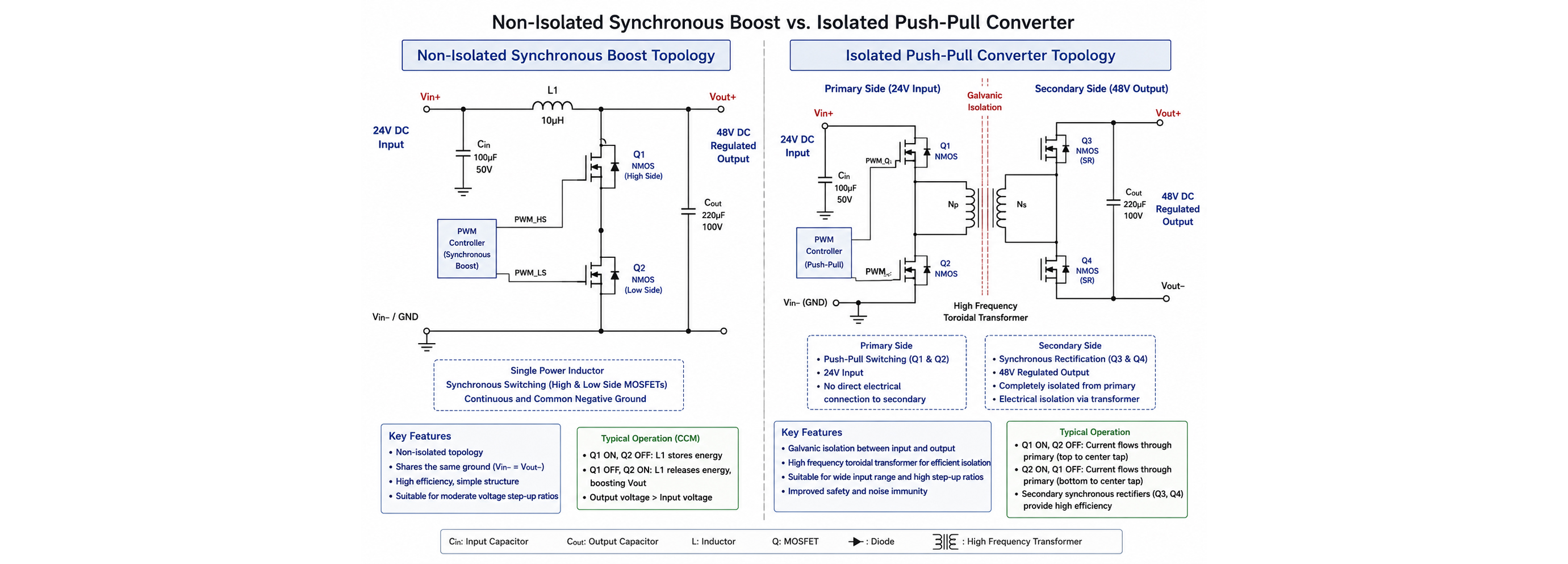
Figure 1. 24V to 48V DC-DC Converter Architecture Comparison
2. Input Voltage Window and Transient Surge Immunity
Industrial 24V DC power distribution networks within contemporary automation paradigms exhibit a widely documented vulnerability to profound voltage anomalies. These systemic deviations from the ideal steady state primarily manifest as deep inductive sags, periodic cyclic fluctuations, and high-energy transient surges. As a representative empirical manifestation, during the startup activation sequences of heavy-duty electric motors, the resulting inrush current induces severe transient loading. Consequently, the nominal 24V bus rail can experience a momentary voltage collapse, temporarily depressing the terminal voltage to a critical threshold of 16V or lower. If the selected converter features a constrained input range, it will frequently trigger Under-Voltage Lockout (UVLO), halting downstream system operations. Conversely, inductive load shedding can clamp destructive surges exceeding 36V onto the rail. Hardware teams must prioritize converters featuring wide steady-state input windows (such as 9V–36V or 18V–36V ultra-wide input capabilities) coupled with rugged front-end transient voltage suppressors (TVS) to guarantee absolute failure-immunity.
3. Thermal Derating and Power Conversion Efficiency
Thermal stress is the primary thermodynamic nucleus responsible for empirical component degradation and field failures. To systematically evaluate the thermodynamic implications within high-power electronic systems, consider a power conversion apparatus operating at a nominal capacity of 1000 W. When functioning under an empirical efficiency threshold of 92%, this system inevitably converts and dissipates a substantial magnitude of 80 W as parasitic waste heat concentrated within the internal confines of its enclosure. Conversely, migrating the system architecture to a premium, high-efficiency module capable of achieving a 96% energy conversion threshold abruptly curtails the internal power loss to a mere 40 W. This architectural optimization effectively yields a 50% reduction in the total thermal dissipation burden, thereby significantly mitigating the internal ambient temperature rise.
Hardware design engineers must strictly avoid the systemic flaw of executing component selection and structural optimization based exclusively on ideal room-temperature ratings. Instead, a scientifically rigorous engineering methodology necessitates a meticulous, multi-dimensional evaluation of the empirical thermal derating curves across the intended operational lifecycle. Under challenging operational boundaries, such as hermetically sealed enclosures or harsh outdoor environments where the ambient temperatures exceed a critical threshold of 50°C, passive cooling modalities become highly inadequate. Consequently, the strategic integration of forced-air active cooling mechanisms, high-mass aluminum heatsinks, or advanced thermal interface materials (TIMs) characterized by ultra-low thermal resistance is absolutely vital to preclude localized thermal runaway and subsequent catastrophic degradation within critical internal sub-components.
Table 1. Operational Efficiency and Thermal Metrics of a Standard 1000W Converter
Load (%) | Output Power (W) | Input Current (A) @ 24V | Efficiency (%) | Case Temp Rise (°C) | Inductor Temp Rise (°C) |
10% | 100W | 4.35A | 91.8% | 3.5°C | 4.2°C |
30% | 300W | 12.82A | 94.5% | 8.2°C | 9.5°C |
50% | 500W | 21.09A | 95.8% | 13.1°C | 14.8°C |
80% | 800W | 33.64A | 96.1% | 20.4°C | 22.1°C |
100% | 1000W | 42.19A | 95.6% | 26.5°C | 28.3°C |
4. Output PARD (Ripple & Noise) and Multi-Protection Regimes
Periodic and Random Deviation (PARD), or output ripple and noise, must be tightly bounded. High-frequency noise riding on the 48V rail can pollute sensitive analog measurement instrumentation or corrupt industrial communication signals (such as CAN-bus or Modbus data packets). Ensure the converter incorporates multi-stage LC filters to keep PARD low. Furthermore, a failure-immune industrial architecture demands bulletproof protection mechanisms. The converter must feature auto-recovery Hiccup-mode short-circuit protection, constant-current latching for heavy capacitive load charging, Over-Voltage Protection (OVP), and Over-Temperature Protection (OTP) with thermal shutdown hysteresis.
Need custom bidirectional isolation topologies or high-power configurations? Submit your exact electrical parameters and mechanical boundary requirements to our senior engineering team today for a comprehensive, free technical evaluation.
This technical article is reviewed and officially verified by David Zhang, Chief Power Supply Engineer at IDEALPLUSING, ensuring compliance with strict EEAT principles and high-fidelity industrial reliability guidelines.
Conclusion
Selecting a 24V to 48V DC-DC converter for demanding industrial networks extends far beyond simply matching nominal input and output voltage parameters. To secure reliable, uninterrupted long-term field deployment, engineers must carefully evaluate topology isolation, analyze real-world thermal derating behaviors under extreme load margins, and specify comprehensive protective frameworks. Prioritizing converters built with premium components and robust transient immunity guarantees field-immunity and ensures systemic operational integrity.